


State won’t dive into reopening
Process is like testing the waters, with many goals still far off
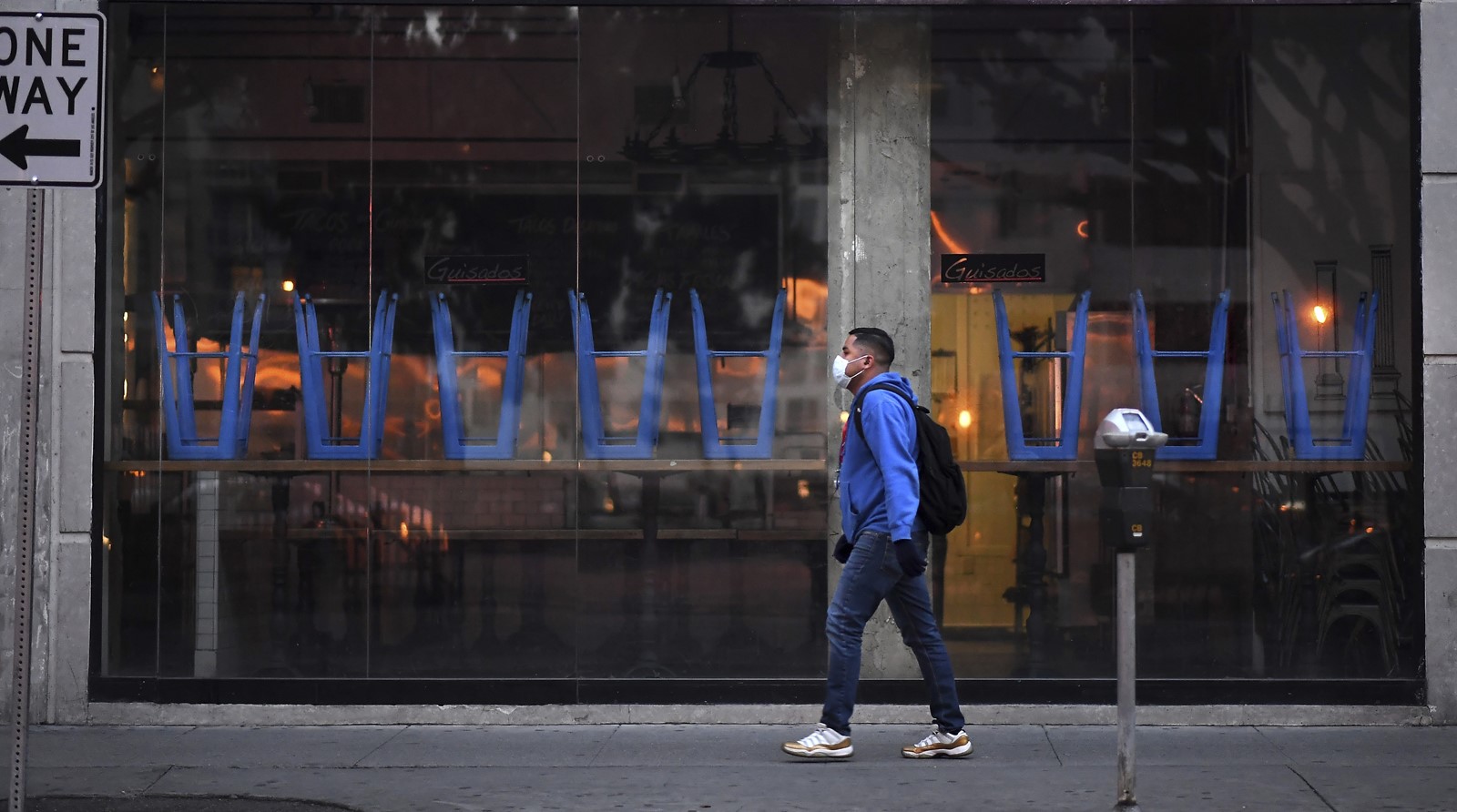


Much of the four-stage plan Newsom released this week relies on vast changes in the state’s ability to both test and track new cases of coronavirus infection.
To this point, California, the world capital of high-tech innovation and capital, has lagged behind other states in building up those most basic elements of isolating the virus.
State officials said they are testing more than 20,000 people a day — a third of the minimal daily tests needed to reopen.
Newsom said that a Minnesota healthcare company, OptumServe, would open 86 new testing sites by Monday, mainly in inland and poorer urban communities that have had much less testing than more affluent areas. But he has declined requests from The Times to release details about the sites, including their locations. One expected site in Humboldt County probably won’t be operational for weeks, according to health authorities there.
And full-scale testing will probably be easier to accomplish than the second key benchmark: having widespread contact tracing in place to follow the chains of infection and isolate them. This will require an army of trained volunteers to find out where an infected person caught the virus and to whom they might have passed it.
In a state of 40 million, this would be a massive undertaking, relying on residents’ willingness to cooperate with the new intrusion into their privacy — an already controversial notion, as Google, Apple and other tech companies found as they waded in with tracing apps.
The other key elements of the plan: Hospitals must have the capacity for a surge of new cases, and the supply of personal protective equipment needs to ramp up drastically to supply tens of millions of masks a month, not just for healthcare workers but also for teachers, students and workers.
With all that hypothetically in place, California’s strategy to get to Stage 2 is essentially like stepping into a pool with the water up to your knees before taking a plunge.
Schools, day-care centers, retail businesses, offices, factories and certain public places open first, with modified hygiene and social distancing measures. This is going to mean major changes in the way merchants do business. Restaurants are probably going to have to reduce the number of tables, and retailers may need to limit how many people go into the store at one time or offer curbside pickup for nonessential items. Barbershops may need to keep every other chair empty.
Bonnie Subnick, who owns a beauty salon in Huntington Beach, said that she will do whatever it takes to reopen but that the social distancing requirements will bring changes.
“It’ll be a totally different world for us going back,” she said. “I think between that and wearing gloves and masks it’s just going to be not as personable.”
When this will happen is not clear. Newsom has talked about “weeks, not months.” He said the new school year could start as early as July but has given no definitive timeline other than that.
Once the initial reopening occurs, public health officials then need time to assess whether the measures are working.
If coronavirus cases rebound and public health officials cannot trace and isolate outbreaks, the state gets out of the pool and returns to Stage 1, with the current stay-at-home order.
If officials can keep the virus from running rampant, the state moves to Stage 3, opening up hair and nail salons, gyms, movie theaters, in-house church services, weddings and sporting events without live audiences.
Big in-person events such as crowded Dodgers games, concerts and conventions come last, in Stage 4, once effective treatment for the virus and/or a vaccine is developed.
Dr. Robert Kim-Farley, a medical epidemiologist and infectious-disease expert at the UCLA Fielding School of Public Health, said he expects Stage 2 to occur in mid-June through July, after a significant decline in cases.
Kim-Farley expects Stage 3 to occur around August or September, and Stage 4 may not come until the middle or latter part of 2021. Loosening of the rules may come earlier or later, depending on the number of coronavirus cases, he said.
But just getting to stages 2 and 3 is what many business owners and employees are eager for.
Alex Maslansky, co-owner of Stories Books & Cafe in Echo Park for 12 years, said he has “really only a couple of weeks” left before being forced to permanently close.
His desperately needed loan from the Paycheck Protection Program, or PPP, has not arrived.
“I’m done counting on any more outside help,” Maslansky said. “If we don’t get those PPP funds, it’s over.”
The bookstore continued to receive and fill online orders since it closed in mid-March. On Monday, the cafe reopened for to-go orders as a way to generate more revenue.
Maslansky, 40, believes his business has survived this long only because of the generosity of patrons.
“The support from everyone has been extremely touching and incredibly helpful,” he said. “Even with that, it’s just not enough.”
Subnick, 54, expects demand will be high when she reopens her salon in Huntington Beach after more than a month off from styling her clients’ hair.
Two days before the salon’s reopening, Subnick said, her cleaning crew will go in to disinfect the entire area. Stylists will also be asked to clean out their stations and to sanitize their equipment. Capes and smocks will immediately be placed in the salon’s washer and dryer after every client.
The salon has already spent about $700 on disposable masks, hand sanitizer, disinfectant and a plastic shield that will be installed at the front desk, Subnick said.
Subnick said she’s determined to hold on to her dream business, refusing to even consider closing for good.
“I’ll die before that happens,” she said. “I finally got to this point. I’m just hanging on by a thread, but I’ll be the last man standing.”
Another big question is whether some parts of California will reopen before others. Some rural areas have seen relatively few cases and are clamoring for Newsom to allow them to ease restrictions. Other harder-hit areas, such as Los Angeles County and the San Francisco Bay Area, are urging more caution.
And some counties are pushing to move forward on their own timelines under plans at odds with Newsom’s order. Modoc County, one of California’s least populated, with fewer than 9,000 residents in the northeast corner of the state, plans to allow all businesses, schools and churches to reopen starting Friday, as long as people inside them can stay six feet from one another, according to a statement signed by county officials. Restaurants and bars would be allowed to host diners, but only at half of capacity.
Modoc County is one of four California counties to not report a single case of coronavirus infection.
