


Surroundings
A million-dollar view — from a van
How vehicle dwellers survive in parking lots at the San Diego area’s public beaches.
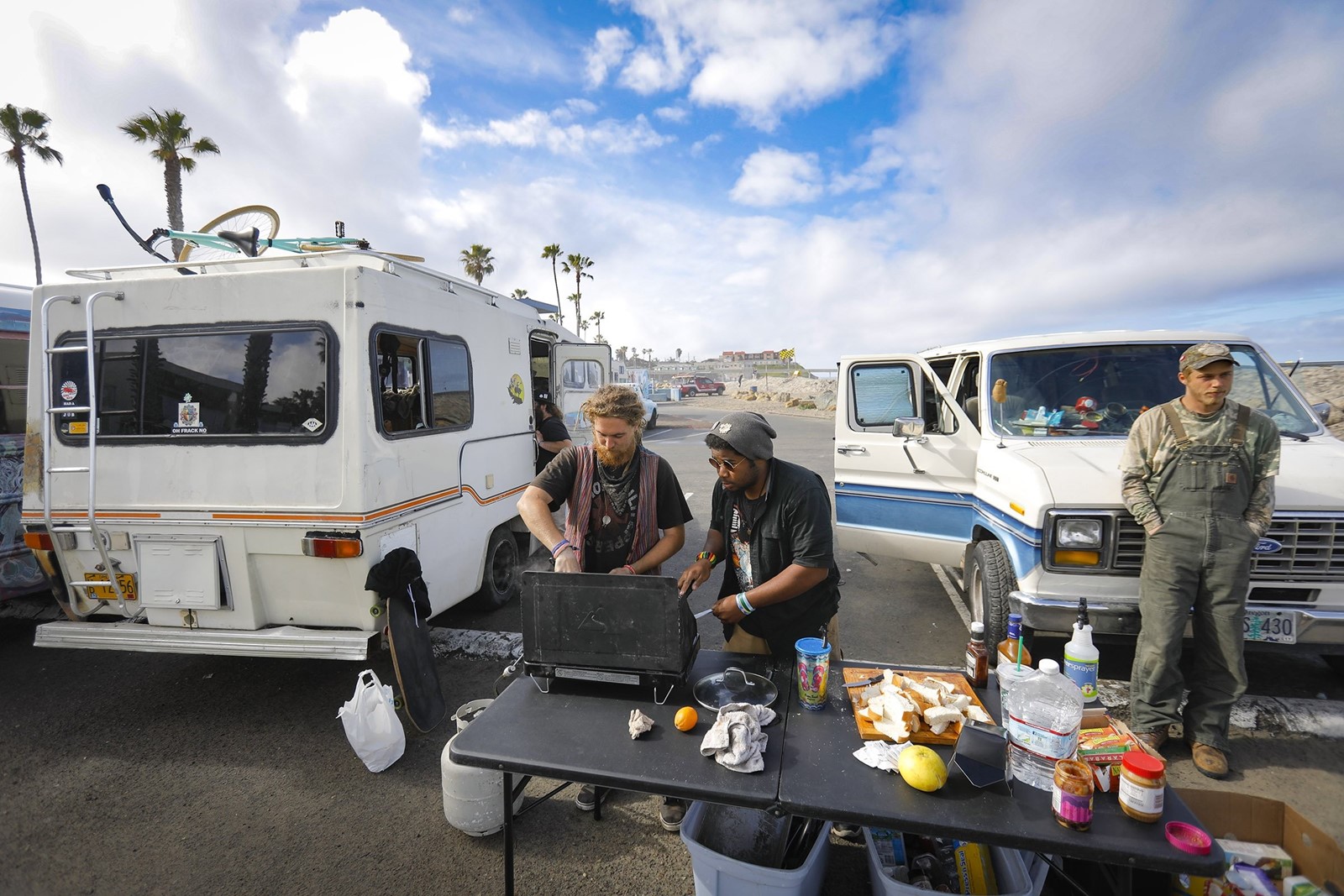


Or at least it does for 22 hours a day. From 2 to 4 a.m., the law requires this home — a rusting Ford Econoline van — to leave its usual spot in a public parking lot beside the sand dunes of Ocean Beach. During those two predawn hours, it roams the surrounding residential streets.
Before sunrise, though, the van and its owner — Noodle, he calls himself — will return to the beach.
“I always come back,” Noodle said. “It’s beautiful here and you are on the ocean.”
There’s one more advantage: Since February, Noodle’s seaside slumbers have been legal. The San Diego City Council repealed an ordinance forbidding overnight stays in parked vehicles, despite the objections of local homeowners.
“If you allow people to sleep in their vehicles, you will eventually have open camping all along our view corridors, such as Sunset Cliffs, Ocean Beach, Mission Beach, Pacific Beach and La Jolla,” Glen Volk of Ocean Beach told the council. “We have witnessed people urinating and defecating in our streets, alleys and city parks.”
Although she say she understands Volk’s frustration, Grace Helms argues that all vehicle dwellers are being blamed for the actions of a few.
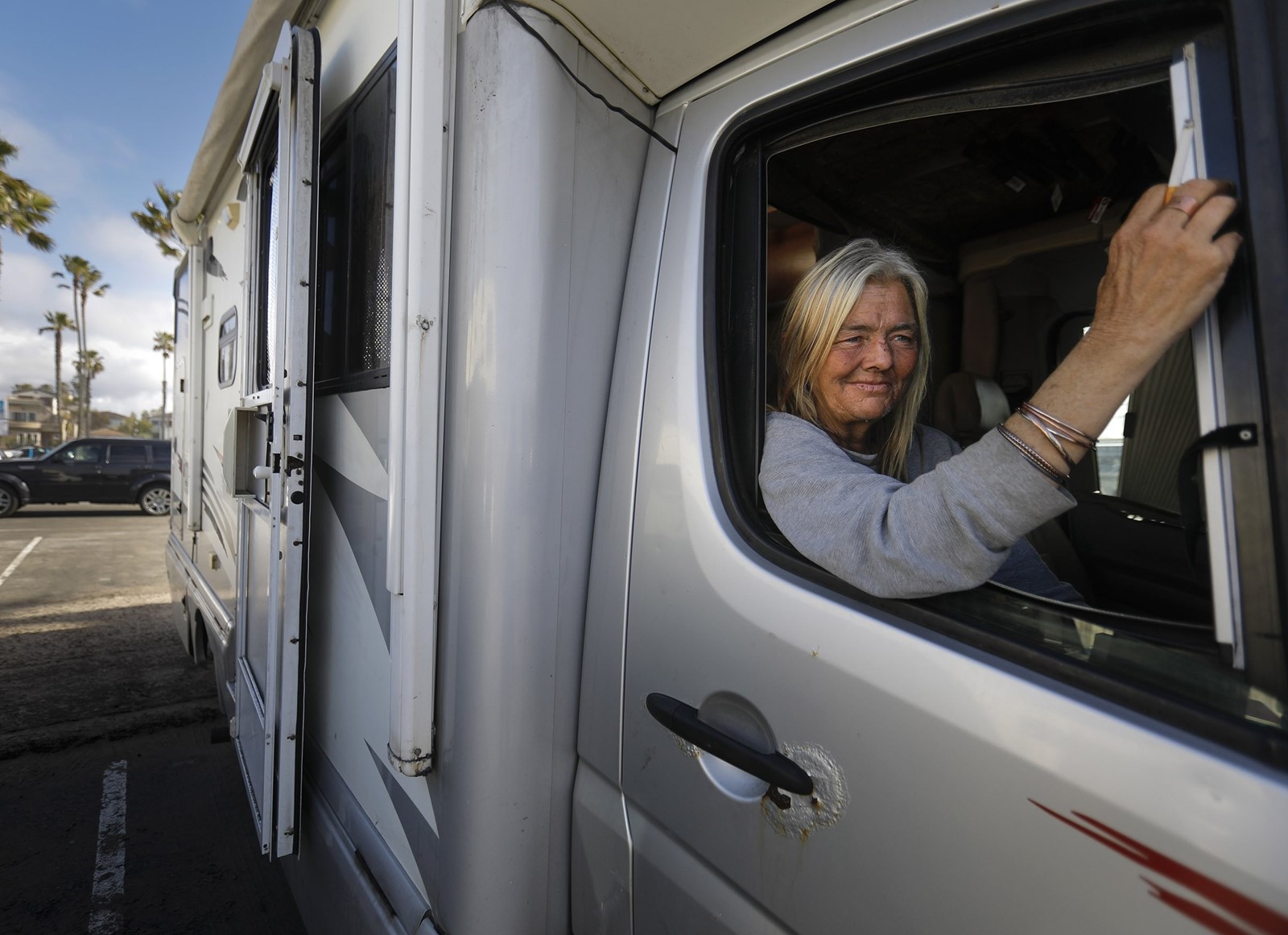
“There’s a ton of push-back from the community, even for the people who do this well — and I do it well,” said Helms, 59, whose 27-year-old Tioga camper was parked a few spaces behind Noodle’s Econoline. “I’m not an addict. I don’t make a mess.
“I’m pretty much the Neighborhood Watch.”
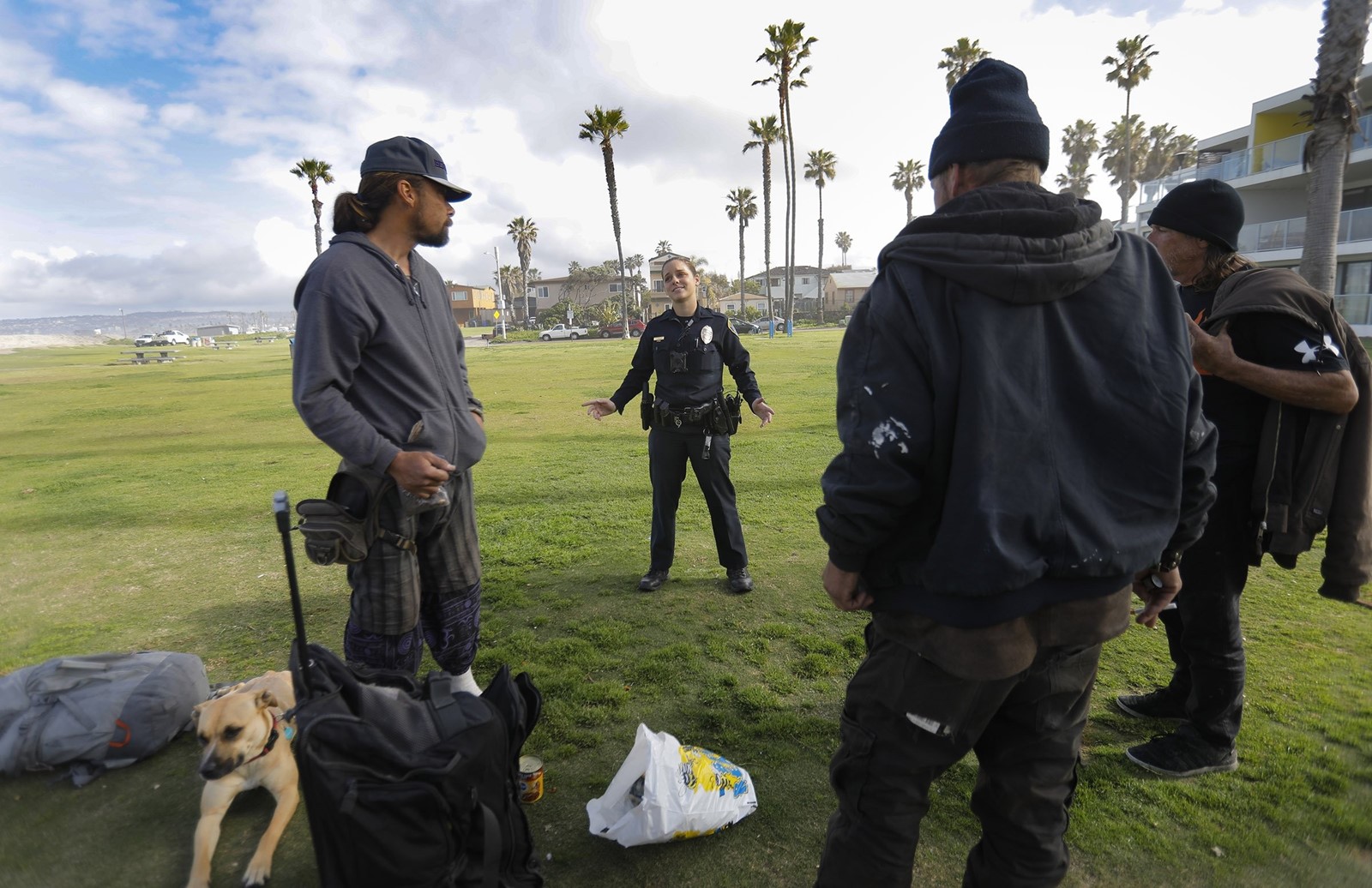
Like any other part of the city, seaside parking lots have good neighbors and bad. Vehicle dwellers have a few common characteristics — virtually all travel with dogs — but this is a varied group.
Some are virtually homeless, living hand to mouth. Others motor around the country by choice, camping in elaborately tricked-out vans. Some vehicles are marvels of Marie Kondo-ish tidiness; others are rolling junkyards.
Regulars in oceanfront lots cherish the sea breezes and deal with the limited hours. (These vary from lot to lot; La Jolla Shores may be the most restrictive, banning motorists from 10 p.m. to 4 a.m.)
Still, the beach-lot lifestyle isn’t for everyone. Lola Cheatham, a mother who spent four years in vehicles with her three youngsters, said they were no place for a family.
“Everyone is allowed to do what they can get away with, drinking, drugs,” said Cheatham, who preferred the four inland “safe parking lots” run by local nonprofits. “I had to have some semblance of normalcy for my kids.”
For Noodle, a 28-year-old Arizonan who has been on the road for eight years, there’s nothing like the beach. Most mornings, he rises early to cook breakfast on a two-burner butane stove, the entire menu provided by a local church’s food pantry.
He feeds all comers, including his van’s four other inhabitants — two men and two dogs.
“The homeless need more food, need more showers, need better laws,” Noodle said, his sun-bleached dreadlocks framing intense brown eyes. “It’s basically illegal to be homeless. They make it illegal to sleep.”
Trial by fire
Although San Diego and Los Angeles recently eliminated laws forbidding sleeping in cars, more cities are moving in the opposite direction.
“The fastest-growing category of punished conduct is the use of vehicles as shelter,” said Tristia Bauman, senior attorney for the National Law Center on Homelessness & Poverty. “These are parking restrictions that, as a practical matter, leave people who live in vehicles no place to go.”
Between 2006 and 2016, the center found, the number of cities banning sleeping in vehicles rose 143%, forbidding the practice in 73 of 187 cities. The center is now updating this survey, Bauman said, and “we will again show an increase.”
Adopted 35 years ago, San Diego’s ban was repealed after a judge declared the ordinance unconstitutional. The law was so vague, U.S. District Judge Anthony Battaglia argued, people had been cited for reading in their cars.
Battaglia’s ruling followed a 2014 U.S. 9th Circuit Court of Appeals decision striking down L.A.’s ban due to the ordinance’s similarly ambiguous wording.
Yet it remains illegal to use recreational vehicles as a residence in San Diego. That law is now being challenged in court, with critics saying it discriminates against the disabled. Faced with high rents and homeless shelters that are ill-equipped to accommodate people with special needs, some say that RVs are their only alternative to living outdoors.
“More and more people are unable to afford market-rate housing,” said Bauman, one of the lawyers fighting the RV ban, “and their vehicles are a last resort.”
That was Cheatham’s predicament. In September 2014, she lost her lease on a North Park apartment just as she separated from the father of her children.
Unable to find an affordable rental, she packed her meager belongings and three kids — ages not quite 1, almost 3, and 9 — into a Volvo station wagon. In this cramped space, she home-schooled the kids while studying acting at San Diego City College.
She encouraged her children to see this as an adventure. When the car was overrun by cockroaches and bedbugs, that was difficult.
“That was trial by fire,” she said.
Yet Cheatham’s worst nightmare was not the vermin. It was the parking fines.
“Once our registration was expired,” she said, “and I got two or three tickets a week.”
Unpaid tickets can lead to authorities impounding a vehicle — which would have left Cheatham’s family out in the elements.
Citations “can mean the difference between someone having rudimentary shelter or not,” said Bauman, the National Law Center lawyer. “They would be out on the street, adding to the unsheltered population that is already incredibly problematic.”
Cheatham settled her fines and kept her car. Although tempted to park overnight on Fiesta Island — “they have a restroom we could use” — she opted instead for a safe parking lot.
Jewish Family Service runs one lot on Balboa Avenue and another on Aero Drive. Together, they can accommodate 200 people each night. Volunteers screen campers, barring sex offenders, and provide tutoring and playtime activities for kids; access to clean, well-lighted restrooms; and outlets to charge electronic devices.
“These are not the persons struggling with drug addiction or alcoholism or mental illness,” Michael Hopkins, the agency’s CEO, said of this clientele. “Most are dealing with the gap between their income and the cost of housing.”
Another nonprofit, Dreams for Change, runs two additional lots, one on Imperial Avenue and the other on 28th Street.
“We’ve never had enough capacity to park everyone,” said Teresa Smith, Dreams’ CEO. “People come to us because there is a sense of safety and security. When people park on the street, they sleep with one eye open.”
The lots also help people find jobs and homes. In December, Cheatham, her children and their father qualified for a three-bedroom, two-bathroom house in Mountain View.
The couple isn’t completely reconciled, but they came together to provide a roof — one that’s not welded to a chassis — over their children’s heads.
“We’re working things out,” said Cheatham, 37. “The most important thing is to have a stable place for our kids.”
Stigmatized
Unlike Cheatham, Lily chose this lifestyle. In October, the 32-year-old singer-songwriter sold her Nashville home and moved into a 2017 Chevy Cargo van with a high top. Moving west at a leisurely pace, she landed in Ojai, settling down in a rented apartment.
Briefly. Then she was back in the van and back on the road.
“I grew restless,” she said. “I feel fortunate to have had this opportunity.”
Still, there are drawbacks. Her parents, who live in the Los Angeles area, aren’t thrilled with her living arrangement. Even Lily — who, like many interviewed for this story, declined to give her last name — senses a stigma.
“Sometimes I feel a little gross and seedy getting out of my van,” she said.
Her late-model vehicle isn’t cozy on winter nights, even in San Diego. “I’m too cold,” she said, wrapped in sweater, jacket and stocking cap on a cool March day. “I need more insulation.”
Still trying to launch her indie folk-rock career, Lily plans to move on. If she lands a few local gigs, she may reconsider.
“If I had a nice job in San Diego, I don’t think I’d feel guilty” about parking on the beach, she said. “I’d feel like ‘This is my city.’ ”
Matthew Sfaelos, 23, complained that residents confronted him outside his vehicle parked in the Ocean Beach lot.
“They were super disrespectful, telling me I had to leave,” Sfaelos said. “They threatened me, and that’s what bothered me. They know where I live.”
Helms said some of the most difficult people she deals with are themselves homeless or living in cars. “The drug use, the alcoholism, the people passed out on the sidewalk ... that can all be enforced,” she said. “When it’s not, it incites people against all of us.”
