


‘Barbie’ power
America Ferrera emerges as film’s secret weapon — a mighty mom
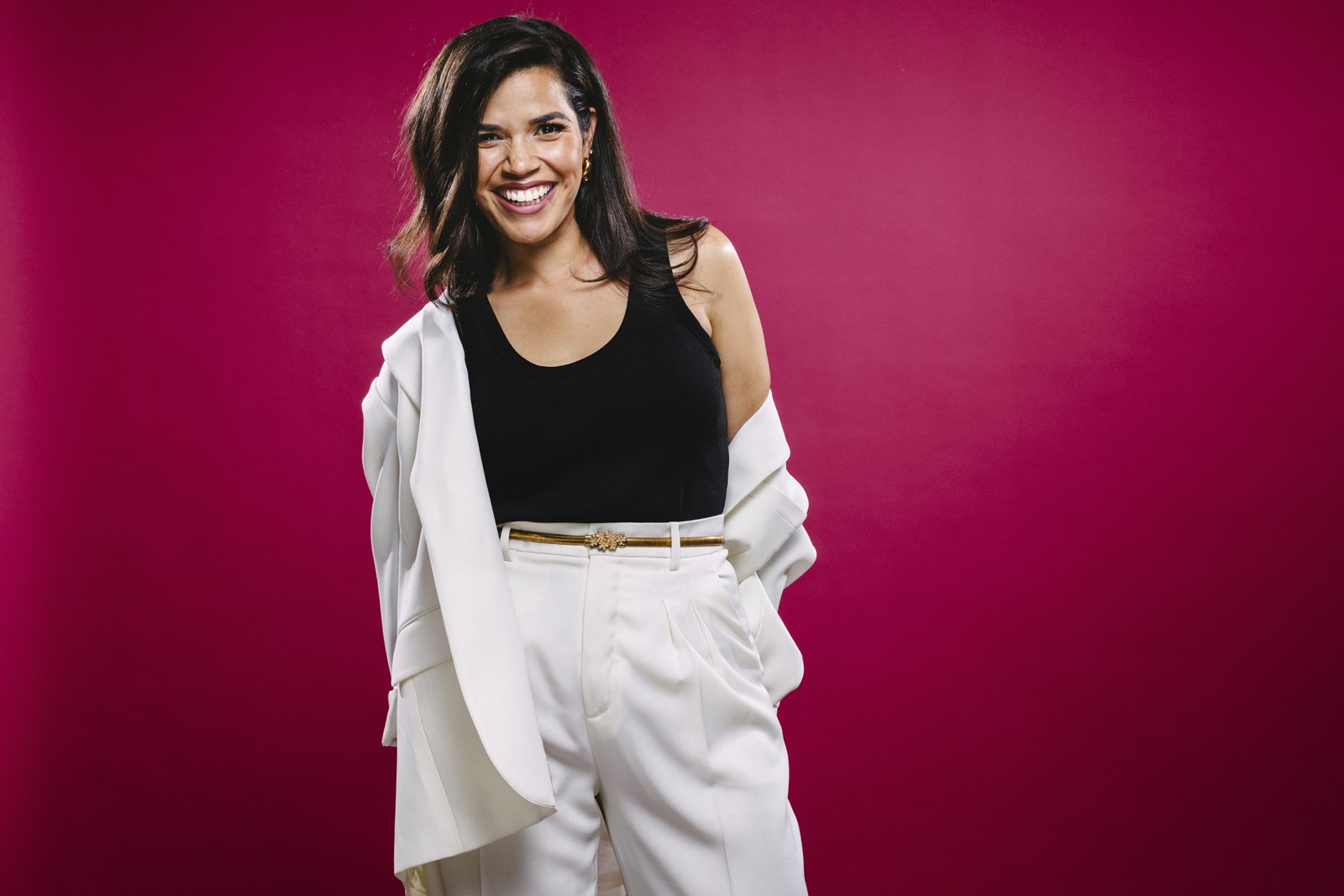


She didn’t have Barbie dolls at home — her family couldn’t afford them, Ferrera says. She played with them only while visiting a cousin’s house. So co-starring in a summer blockbuster about the enduring American symbol of girlhood, in all its bubblegum-pink glory, wasn’t wish-fulfillment for her.
“I don’t really remember the Barbie world ever resonating with me,” Ferrera says. “I imagine that’s because I didn’t feel very represented or reflected by it. Never in a million years did I imagine that I would be part of a Barbie movie. I was the little girl who didn’t see myself in the mainstream culture around me, and I know how important it is to feel seen.”
Ferrera may not have grown up turning to the 11
And now, as an adult, Ferrera finally has her first Barbie: A number of collectible figures were created by Mattel to celebrate “Barbie’s” release, including one in the likeness of her character, complete with flowing black hair, hoop earrings and an all-pink power suit.
“It felt so surreal, I don’t even know what it means,” says Ferrera, who has made a career out of playing “real girl” characters who challenge Hollywood beauty standards.
“I couldn’t really wrap my mind around it. There’s a Honduran Barbie doll now. That really matters.”
In a conversation last month, steps away from the pink-filled Barbie wonderland created for the film’s press junket at a Los Angeles hotel, Ferrera discussed being part of the highly anticipated summer blockbuster, the powerful monologue she delivers at the heart of the movie, and what it’s like being directed by Gerwig.
The interview, which took place before the SAG-AFTRA actors’ strike, has been edited and condensed.
It was kind of a miracle. Things like this have rarely, if ever, happened in my career, where you just get a phone call from some fabulous director who says, “I have a part, and I want you to play it.” That kind of thing doesn’t often happen for Latinas in this industry. There are so few roles created for us, and it’s not in $100-million movies that are about cultural icons.
Exploring it through Gloria’s eyes just felt like a magical gift that we never get in our culture — and if we do get it,
It’s just so tickling that this is the version of the Barbie story we get, because it could have been so many things. If it was just glossy and pretty, and you just looked at Margot Robbie and Ryan Gosling, that would have made money. It didn’t have to be this version.
She shows up on, like, Page 30, and the way Greta introduced her on the page was with her shoes. I believe it said something like, “This is Gloria, we love her immediately.” And I was like, “I
Gloria is an adult woman who feels this deep connection to Barbie, something that made her feel aspirational, optimistic, but that she feels she’s not allowed to have, because she’s grown, because it’s complicated, because she’s complex: I love this thing, but I’m going to hide it. It feels very resonant with the whole [theme] of all of us getting to be more of what we are, without apology.
What they do for each other is release each other from an impossible assignment: to be a thing. And we need to hear that.
Men, women, all genders — we’re given roles. And because of our nature, or whatever it is, I’m not a psychologist, we do the assignment. And to get to a place where you’re like, “This is an impossible assignment, and I’m sick of it,” that’s the deeper invitation for the audience.
I feel like that’s what resonated with me the most, this permission to be unapologetically all of the things that we are. That’s what Greta is. She’s this Academy Award-nominated director, who probably feels all this pressure to make the next big thing. And she’s like, “I’m gonna go do f— ‘Barbie,’ and watch me. Watch me do ‘Barbie.’ That’s the guts, to claim the permission to love what you love, to be all of the things you are, without having to equivocate or explain.
When I first read it, it just hit me as the truth. There’s no woman in my life who those words aren’t true for. Not a single one. So it felt like a gift. And it felt very intimidating, because Greta was like, “I hope you enjoy the script. Also, there’s a monologue that Meryl Streep said she’d like to do, but it’s for your character. So, enjoy.” And I’m like, “What?”
Actually, what Greta said to me was, “Meryl Streep said that this was the kind of monologue she has been waiting her whole career to say” — something like that, which put the pressure on early.
All that’s said in the monologue is just the truth. And when we hear the truth, it hits in a certain way, and you can’t unhear it, right?
I felt like I did it 500 times. It’s rare as an actor to get the opportunity to get to play a moment like that, to really swim in it and love it and try it out a million different ways. Greta never gave me a target. We talked about it, but she wasn’t like, “I want you to laugh
She had so much trus t in me, and I had so much trust in her. They were really intense days on set for me. And I felt like they were intense for the crew too, because they were listening to it. I had a lot of crew members come up to me and say, “Wow, I really heard that.”
She is an encyclopedia of film references and cultural references — literature and poetry and music.
One of the first things we did in prep, she gave me a list of movies to watch, to just get in the feel and the vibe of “Barbie.” I’d text her about it, and she’d text me about and we’d have a conversation.
There was nothing flippant, nothing dismissible. Everything mattered. And that was a gift to everybody on the project. Everyone got the invitation to work at the height of their craft, but for the purpose of play, for the purpose of joy-making imagination.
When I first walked onto the set — again, I did not play with Barbie, so I didn’t have this, “Oh, my God, the Dream House!” reaction — I remember seeing this incredible shot that Rodrigo Prieto, Martin Scorsese’s [cinematographer], was doing of these incredible sets, and the hair and the makeup and the wardrobe and the colors and the lights. And I gasped. I got a little bit emotional. And I thought, “Why? What is this evoking?” And for me, it was just a nostalgia for imagination, a nostalgia for unapologetic play in the most artful and beautiful way.
Gloria had this desire to express, but it was very hidden. So the shoes are under the desk, and when you first meet her, waist up, she’s exactly what she’s supposed to be in that space. Everything that’s fun about her is hidden. She’s wearing a sparkly pink belt, but
Then she just came back with a shirt mullet. It was business out front and party underneath. In the scene, you see the blue lapels, but in the next scene where the blazer comes off, it’s white and pink pinstripe. And you find a glittery belt. And it was like, “Yes!”
Those were questions with Greta: When we go to Barbie Land, are we Barbies? Are we a Barbie
No. Not at all. I think I said to Greta after I read the script, “I’m so honored that you would have thought of me for Gloria. If I’d had my pick to play anyone in this movie, it would be her.”
It’s like a shot of dopamine. It’s like a candy shop. It’s like I ate a cake and I want more cake. It’s so beautiful. It’s the sets, but then it’s the clothes. All of it. And the wig room was unbelievable. It was just hair everywhere. Barbie has a lot of hair.
I just wanted to be an actress. I just wanted to have a career, I just wanted to make my dream come true. I didn’t set out to challenge stereotypes or represent anybody. I wanted to live my dream. And it’s been a part of my career because of who I am, and because of what people see when they look at me. I think that resonates so deeply with people because it’s still a battle we’re fighting.
I’ve had to spend my whole life challenging stereotypes, but I’m also just a person trying to figure it out for myself. At the time of my career starting, I was a 17-year-old
The day that Greta sent me the “Barbie” script was also a day that I signed a CoverGirl contract. And I remember [
I’m a woman in this world and I have deeply struggled with my own sense of worth. And as much as I want to say that I escaped that, that I’ve evolved past that, those stories are so deeply ingrained. And it’s not easy for me because it can’t shift in the culture until it shifts inside of us.
Healing Generational Trauma Barbie. Like, where is she? Give me her. She’s tired. She’s exhausted.
‘Barbie’
and brief language
54 minutes
