


One lab’s efforts to improve the reliability of public EV chargers
Ease of obtaining power is a key hurdle to wide adoption of electric vehicles.
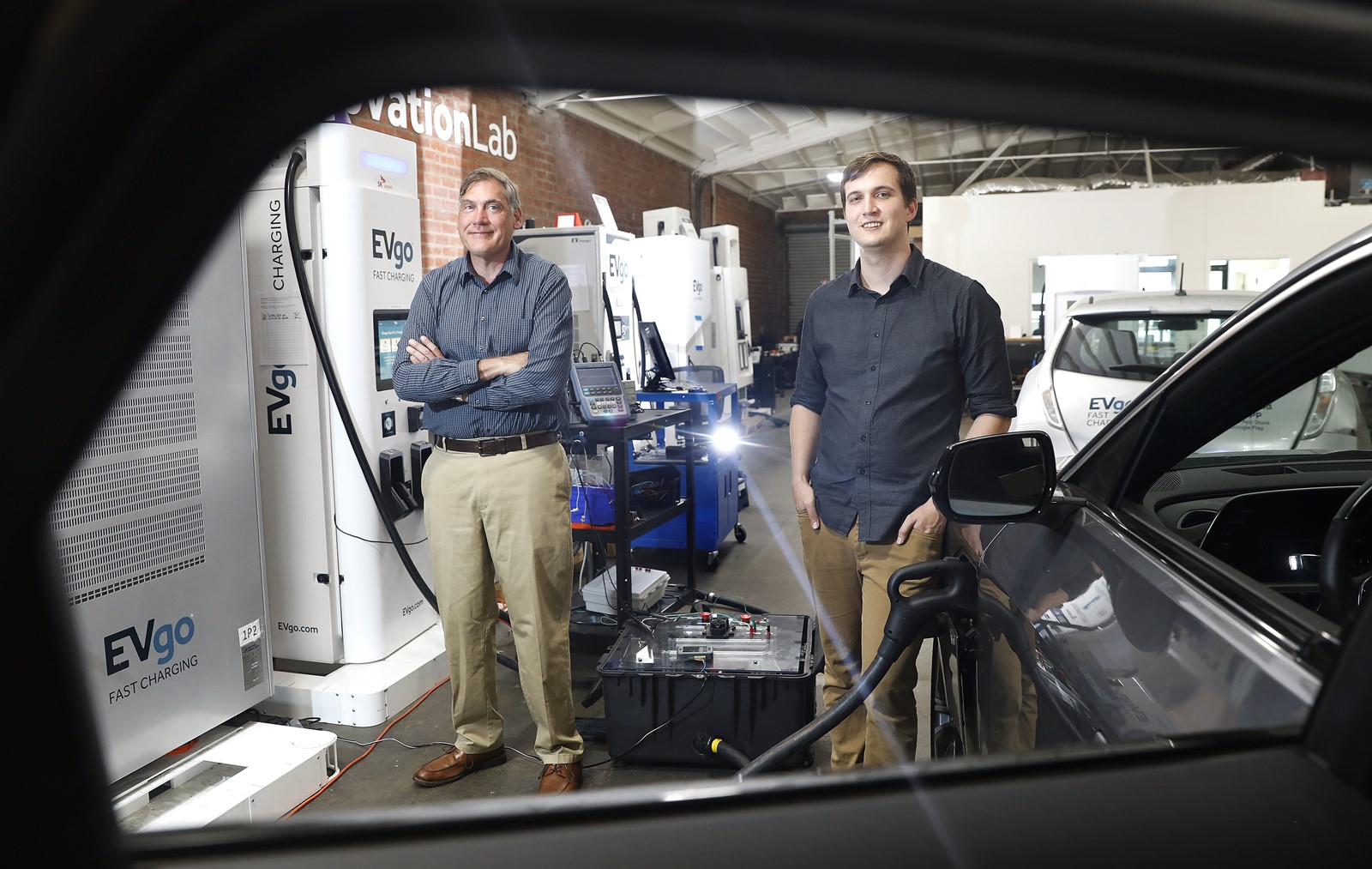


Bryce Wynter grips the handle at the end of an electric car charging cable. He raises his arm, then throws the heavy handle, hard. Deliberately. Onto a concrete floor.
“Sometimes people just toss the thing when they’re done charging,” he said. “We need to make sure it doesn’t break.”
The drop test is done from eight different angles. Sometimes the handle’s pounded with a heavy hammer. Then the thing and its cable are submerged in a big, blue, garbage-can-size barrel filled with saline solution and left to soak. If it still works after all that, it clears another hurdle on EVgo’s reliability-test marathon.
Wynter is a systems engineer at the EVgo Innovation Lab in El Segundo. It’s located in a large brick-walled garage hidden behind a row of old houses.
Improving the reliability of the public chargers it sells and operates is a top priority at the lab. Thus far, though, the reliability record for public EV chargers is poor, not just for Los Angeles-based EVgo but for all of the many small companies hoping to grow as the market for electric vehicles continues to expand.
“We want a great charging experience, fairly priced,” said Ivo Steklac, EVgo’s chief technology officer, speaking from a small screen held in the palm of an engineer’s hand, virtually tagging along on a lab tour via Zoom.
“You show up. The charger is ready,” he said. That’s the ideal.
The budding industry has a long way to go. In January, market research firm J.D. Power estimated that at least 1 in 5 attempts at public charging failed. The issue is causing many would-be EV buyers to question whether it’s time to make the switch.
The uncertainty over whether the public charger that a driver is heading for will be working adds stress to the idea of a long-distance EV drive.
Burning gasoline pollutes the air and contributes to global warming, but gas stations are plentiful — and the pumps are reliable.
EVgo knows this. Like all charger companies, it’s rapidly expanding its charger network with newer, better-designed equipment.
In January, EVgo launched what it calls its ReNew program to overhaul existing chargers and replace many older ones and to speed repair time when a charger needs fixing.
A lot can go wrong with an EV charger. Hardware can fail, and software too. Whereas a gasoline pump requires minimal software, a public charger must manage the delivery of electricity to a wide variety of electric vehicles with different kinds of batteries and proprietary battery management systems.
The charger is in effect a computer that juggles credit cards and phone payment apps, dependent on robust cellphone connections. The machines are packed with transistors and capacitors and electronics that can fail.
The federal government, with billions of dollars to spend on charger subsidies, is aiming to reach 500,000 public chargers across the country by 2030. That’s 10 times more than exist today.
To qualify for subsidies, the government will require 97% uptime reliability — but the details on what’s covered by that 97% are still being worked out at the state and federal levels.
Market growth by itself will help improve reliability, the engineers at EVgo say. That’s because parts suppliers, some of which were skeptical about market growth, were reluctant to adopt their products or work with charger companies on new designs — for parts that range from charging cables to digital power-delivery components.
At the El Segundo lab, 12 EVgo chargers are lined up against one long brick wall. “That’s every charger on our network,” said Keith Beckstead, EVgo’s director of charger engineering.
They range from medium-speed 50-kilowatt chargers — the original “fast chargers” — to ultrafast models that can reach 350 kilowatts — enough to go from almost empty to 80% full in 20 minutes or so if the car model can accept that fast a charge. (Not all EVs can. Ask the dealer when you buy your car, or check your manual if you already have one.)
There are also cabinets that hold racks of chargers that can allow, say, a Nissan Ariya and a GMC Hummer to charge from the same piece of equipment at the same time.
The economy’s switch to EVs is still in its early days and the fact that the automobile industry has not yet coordinated its charging protocols means that the digital “handshake” between a car’s software and a charger’s software is a common point of failure, and one that’s hard to diagnose.
EVgo borrows cars from auto manufacturers and tests them with its own equipment, in an attempt to minimize handshake problems.
“We walk down the line, testing every charger for every car,” Wynter said. That’s a time-consuming, labor-intensive hassle. “Right now, that doesn’t scale,” he said. According to Steklac, EVgo is working hard to get automakers, other charger companies and industry standards bodies to agree on standards that could clear the path for the industry as a whole.
Such standards usually take many years to develop. But time is short for the EV industry.
Government mandates, such as California’s ban on new sales of gasoline and diesel cars as of 2035, have added heavy pressure.
If reliability doesn’t improve, and soon, those ambitious goals may prove impossible to reach.
