


THE SUNDAY CONVERSATION
Playing by her rules for ‘Cobra Kai’
Tamlyn Tomita wanted her Okinawan heritage to be part of ‘Kid’ reprise
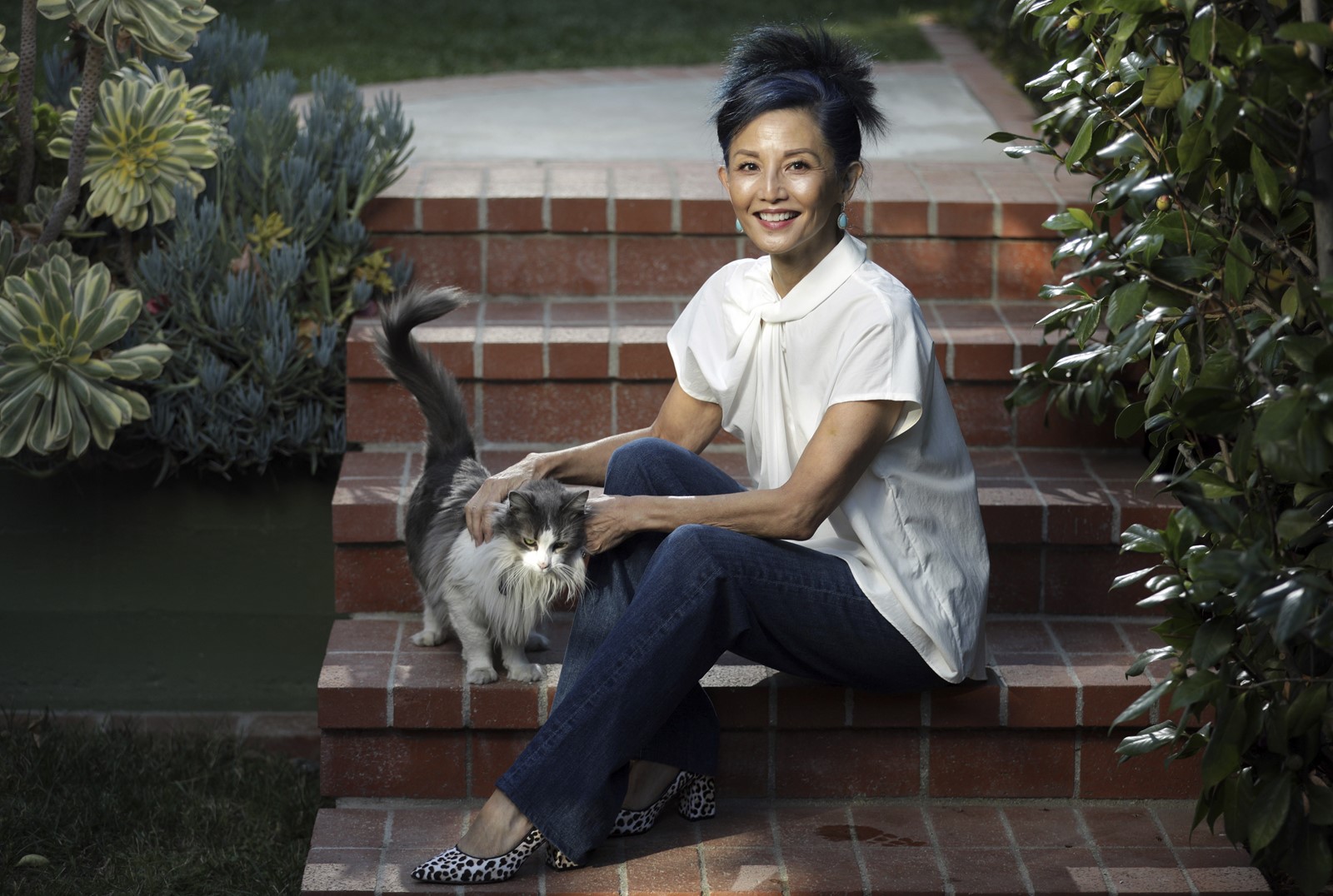


“I said I would love to, this would be so fun, but the only caveat is that because I’m older, because I’m a little bit more knowledgeable and I’m going to fight for it anyway — I need to be able to inject a truer picture of Okinawa,” says Tomita.
Born in Okinawa to a Japanese American father and an Okinawan Filipina mother and raised in the San Fernando Valley, Tomita brought parts of her heritage to the wiser Kumiko of “Cobra Kai” and lent her own cultural items.
A day after driving to Sacramento to cast an electoral college ballot for President-elect Joe Biden and Vice President-elect Kamala Harris — chosen by Rep. Judy Chu (D-Monterey Park), her onetime UCLA professor, to be part of “an extraordinary exercise in witnessing our democracy prevailing” — Tomita dove into her prolific screen career, her return to the “Karate Kid” franchise and her plans to build an inclusive new space for storytellers in L.A.
I was expecting to become emotional but it didn’t come at the places I prepared myself to be. It was signing my name to Kamala Harris’ ballot. I cried when President Obama was elected the first time, in 2008, and it’s been like, “Let’s go, let’s continue on with the hope agenda.” Now it’s the heal agenda. Just signing my name to a madam vice presidential ballot was extraordinary.
It’s hard to break away from that because everybody wants more of the same. [When] people thought I was from Japan or Okinawa I’d go, “No. I’m from the San Fernando Valley.” That was my impatience and my own frustration. I went through that period. I can still be an a— pertaining to having the honor of wearing the Kumiko garments and just wanting to wear a leather bomber jacket! But she is still an integral part of me and I want to put her back on and say: “She still fits.”
You know what? I really do think the original “Karate Kid” is the better one. I think it’s because of the story we didn’t find out about until later, that the studio didn’t want the scene of drunk Mr. Miyagi with his Medal of Honor. Come on! That’s the scene that steals it for everybody.
Can you imagine it without it? Some people gloss over it, especially if you’re not Japanese American: “This is an American story? This happened?”
I’d like to see the Netflix show “Miyagi-Do,” with Chozen [Yuji Okumoto]. He’s the real marriage, the interconnectivity, of what it means to be East and West, karate being embraced by both cultures and what that means. Let’s get them together … let’s see where they’re going to the audience, for Season 4.
The three amigos, Josh [Heald], Jon [Hurwitz] and Hayden [Schlossberg], emailed me out of the blue in 2019. I said I would love to, but the only caveat is that because I’m older, because I’m a bit more knowledgeable and I’m going to fight for it anyway — I need to be able to inject a truer picture of Okinawa. I didn’t know anything back then, and the only sense of Okinawa [in “The Karate Kid Part II”] is through [screenwriter] Robert Mark Kamen’s interpretation of his time spent in Okinawa. I know Pat [Morita] did as much as he could, but he’s a [second-generation] Nisei of Japanese descent, which is different.
[I asked] if I could get the script ahead of time and translate things from Japanese to Hogen, or Uchinanchu, which is the Okinawan dialect. And I took it upon myself to go to the Okinawa Assn. of America and ask for the correct Okinawan choreography to “Tinsagu nu Hana,” the song that me and my mom made up the dance to in “Karate Kid II,” because I wasn’t choreographed for that section of the film. In “Cobra Kai” you only see two seconds of it, but at least I got to inject as much Okinawan as I could.
There are two different impulses. As an artist, we have the responsibility to create that character as authentically as possible. But in ’85 I didn’t know anything about karate and “Tinsagu nu Hana,” the song. The official choreographers for “Karate Kid II” were Nobuko Miyamoto and Jose De Vega, and they were responsible for turning the Obon [Japanese folk] dance to face the camera. [Director John G. Avildsen] said, “Can you create an Obon dance that has the dancers turn around or has more fun, kinetic movements so the camera can capture them?” In Obon dance, you just face the person in front of you.
The day we were filming that on the bridge, the karate and the dance scene, I’m going, “Mom! Do you know any Obon dances with karate?” And she goes, “No!” “I think I have to do some but there’s nobody teaching me.” I didn’t know anything about acting, I didn’t know who I was supposed to call. Am I supposed to call the director?
So we just made up stuff and tried to be as broad as possible so people could see the connection between dance and martial arts, which is important to know because Bruce Lee was a champion ballroom dancer and martial arts king.
Coming back to “Cobra Kai,” it re-echoed. I have to reflect the little town, the little island that I come from, that I was born in, where my mother’s family is from. I’m privileged and lucky enough to know it. I’m not going to throw that onto every other actor who has some ethnic background and say, “You should know it.” That’s upon the individual artist.
We’re trying to mesh our worlds of what it means to be American, what it means to be Japanese American and in the bigger Asian American diaspora. I can’t dictate that to the creators or storytellers, but if they are going to tell that story they have the responsibility to tell it as authentically as possible, and to reach out to folks who can help them achieve that vision with the knowledge that we’re always going to bend to artistic license.
I’m so lucky, because I have the privilege and the luxury to say no. I’m not going to be saddled with another interpretation of what Okinawa is. It was that important to me to bring three pieces of luggage with Okinawan artifacts and art that could color the world and the sets I was on, to reflect what it means to be Okinawan.
Yes. I think there were a lot of things unsaid, because I don’t think those three guys, as young as they are, know how to speak as a woman and they didn’t consult me. Are there things that I would have liked to have said as Kumiko? I think so. But again, I knew as Tamlyn that I had to serve the story. I was just happy to be in service of that but also to serve the giving of the letters to Daniel-san. That’s what was important. And to know that Kumiko lives in the hearts of so many ... I don’t need to write it, I don’t need to speak it. Everybody gets to fill out the story for themselves. A look in their eyes will say, “I will love you, always.” I think that’s enough.
That was a real awakening, because that’s when I realized what kinds of roles were out there. Not a whole lot. I think my first thing after “Karate Kid” was “Tour of Duty.” I played this sweet Vietnamese villager who happens to be the assassin. There were not a lot of roles out there that were not the “Vietnamese refugee,” the “Hmong refugee,” the “Chinatown episode.” I turned to independent film or stage and started to see the opportunities that were more available to me and other actors of color.
I think we learned that change comes excruciatingly slow, and we have to keep opening the door and propping that door open. Make sure the door doesn’t close again! I think the change has come to include more stories out of Asia. In my mom’s Japanese magazines when I was 7 or 8, I saw the Four Leaves and thought, “They look like me.” They looked like the 1960s version of BTS, so when I see BTS and I see Blackpink, I see the connectivity and I’m just so happy that so many of us get to see the talents of so many people from elsewhere. Let’s just open those blinds and see what’s out there.
I have not confirmed this but this is my own interpretation: I know I came in with another name. It was not Commodore Oh, it was Commodore Something Else. But that’s when Sandra [Oh] won her [lead actress Golden Globe] and I think they wanted to honor her. Why else would it change to “Oh”? If I go on with the show, I’ll ask the more important questions. But for now I’m just happy to be part of that universe.
Apparently Cary said, “I want Tamlyn,” because I did not have to audition for that. Cary, being another Nikkei [person of Japanese descent] and Nisei Japanese American, he was deemed the authority on what it means to be Japanese because he’s much closer to the Japanese culture. Cary was able to say, go for it. Reflect your heritage. So I was able to justify that I would be a descendant of the Okinawan women who practice beautifying their hands to show that these are my skills, this is where I come from, this is who I am.
I encourage anybody in the arts and storytelling, if you can reflect your heritage and you want to — you don’t have to all the time! — be brave and ask, “Can I do it?” Because I didn’t know that during “Karate Kid II.” I didn’t ask anybody. But [have] the courage to say, “Can we do this? Because it’s a beautiful part of my culture and being an American I’d like to introduce the whole world to this. That’s what I’d like to convey.” We have more power than we think we do.
Another thing that I continue to fight for, especially during this pandemic time, is the representation of Filipino nurses on medical dramas throughout the decades of American television. I fought for a Filipino nurse regular on [“The Good Doctor”] in the writers room for all three years. But shooting in Canada, there’s not a lot of opportunity for persons of Filipino heritage. It’s something that I’m always very cognizant of. Where are the Filipino nurses? Whether they’re Filipino born or American born, that’s what’s been missing in a lot of the storytelling of American television.
It’s something that I’m very proud of. But I defer to my other Filipino American female artists and storytellers because they’re closer to the true Filipino experience. I’m always seeking out Filipino stories. I’m there to be the cheerleader, to be the amplifier, to be the spotlight focus person to say, these stories exist. And outside my own personal heritages there are so many stories out there that I’ve had the opportunity to tell. I’ve played Vietnamese, I’ve played Hmong, but I know there are actors out there of those ethnicities who could have played them more authentically and more truthfully.
My husband and I are creating a theater, Outside In Theater, that will create stories that are usually underrepresented. That will give chances to people to tell their stories. It’s to showcase the stories that need to be told because they haven’t been given the opportunity to. We bought the building in October and it probably won’t be completed until late 2021, but it is a theater/streaming space. Outside In is going to be in Highland Park, and we’re trying to give opportunities to people who don’t get the chance to tell stories — to invite them in, to know that they all belong.
