


Eaton fire cleanup left toxic soil behind
Unsafe lead levels found in yards even after Army Corps work
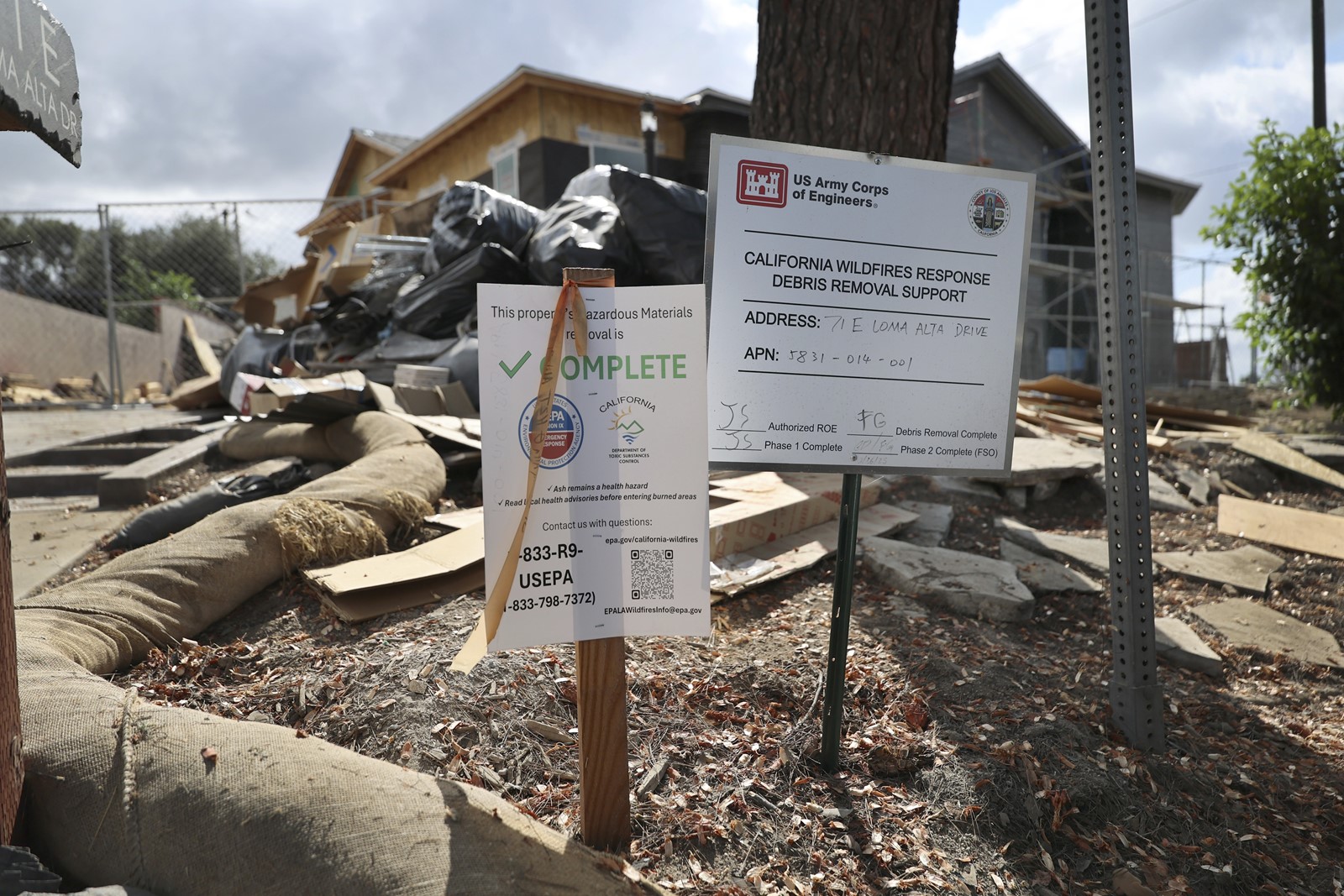


The Eaton fire left significant levels of lead in Altadena’s soil, according to a final report on soil testing from the Los Angeles County Department of Public Health.
The U.S. Army Corps of Engineers hauled away debris and soil from destroyed properties, but that did not completely remove the contamination, the report, released Friday, found.
Meanwhile, homeowners whose homes are still standing, or partially damaged, both within and outside the burn scar, also face significant contamination.
Most experts think the lead in the soil comes from incinerated lead paint that coated most homes built before the paint was banned in 1978. The findings are important because lead can permanently damage the brain, leading to developmental and behavioral issues in kids.
Lead was the only contaminant found in most of the testing. But in Pacific Palisades, the county also noted one cadmium and thallium hot spot and arsenic, a carcinogen, in another location.
“We want people to be paying attention to this in their rebuild process, so that they are reducing any potential risk there,” said Dr. Nichole Quick, chief medical advisor for the Department of Public Health. ”And if they’re in a more high-risk situation, they may want to be taking additional precautions.”
The county hired environmental consulting firm Roux Associates to test the soil for a wide range of potential post-fire contaminants, including heavy metals and potentially hazardous organic compounds that form when things don’t burn completely.
In looking at destroyed homes in Altadena that the Army Corps had not yet cleaned, Roux found that 45% of properties had higher levels of lead than the state has historically deemed safe for residential areas.
Of the 15 properties they tested after the Army Corps cleanup, three exceeded the screening level.
The Times first reported in February that, unlike in previous wildfires, the Army Corps was not testing the soil itself. And it was not continuing to remove soil until properties reached the health-based level.
In past fires, some 20% to 40% of properties have been found to be still contaminated after initial debris removal, requiring contractors to continue rescraping the property and testing until contamination was below health screening levels.
Independent soil testing conducted by The Times provided the first evidence in May that Army Corps crews were leaving behind lead contamination. Subsequent tests by a UCLA research group also found that 49% of the cleaned properties were still contaminated with lead.
“If those numbers hold, this will be the worst cleanup that I’m aware of in wildfire history,” said Andrew Whelton, a professor of civil environmental engineering at Purdue University. “The purpose of cleaning up is to remove the contamination from the site and restore it to safe use so that you don’t get sick and the economic value of the land is returned.”
Although cleanup crews have historically at least tested and rescraped soil within the footprint of the former house, that can still leave problems: yards, homes that are still standing and homes downwind of the fire.
The county found that 44% of yard samples had high lead levels, far more than the 27% of samples taken within the former footprint of destroyed homes — where the Army Corps removed soil.
Meanwhile, more than a third of samples in the burn area were over the screening level and half of standing homes outside the burn scar — where strong Santa Ana winds probably blew contamination in the smoke — exceeded the levels.
The state bases its lead screening level on the likelihood that soil contamination will raise a child’s blood level by one deciliter per milligram, which corresponds to the loss of roughly 1 IQ point. Lead in soil enters children’s bloodstreams when they accidentally consume dirt after playing outside.
The level is designed to be conservative: protecting the most vulnerable kids through years of exposure.
Homeowners — many of whom are also dealing with significant contamination inside their homes — don’t have access to any government program to remediate their soil. So, many are left to fight for insurance money to cover testing and remediation and make environmental health decisions on their own.
This has triggered hot debate among scientists about how homeowners can keep themselves safe.
Part of the challenge, experts say, is that every case is different. Some families have young kids that love to play in the dirt. Others don’t. Some may have little contamination on their lot. Others can have dangerous levels.
An independent USC group that completed soil sampling found that a sliver of all properties tested — just half a percent — had levels that qualify the soil as hazardous waste, over 12 times the state’s health screening level.
Generally, experts encourage homeowners to get their own soil testing done. Los Angeles County is offering free lead soil testing for those most affected by the Eaton fire; however, many experts like Whelton urge homeowners to test for the full range of potential contaminants, not just lead.
For those with contamination, experts say the best option is to completely scrape a layer of soil off the yard and replace it with fresh topsoil.
For those who cannot afford a full scrape, covering contaminated soil with rocks, pavement, grass or new soil can also help limit exposure.
Soil and health experts urge particular caution for families with young children or who are expecting, since both kids and babies in utero are very sensitive to the harmful effects of lead.
Residents can also take simple steps to reduce exposure such as taking off shoes and wiping down pets after they’ve spent time outside, wearing gloves when gardening and preventing kids from playing in contaminated soil.
For residents, “it’s probably more important that they familiarize themselves with their ways to mitigate potential risk than necessarily feel an obligation to do a more dramatic soil remediation,” said Adam Love, vice president and principal scientist for Roux.
For the vast majority of properties, “these levels that we’re talking about are not acute hazardous levels,” he said. To cause significant harm, “they require a lifetime of exposure.”
