


The glorious heart and soul of ‘Barbie’
America Ferrera talks her performance, the Oscar nomination and what’s next for her.
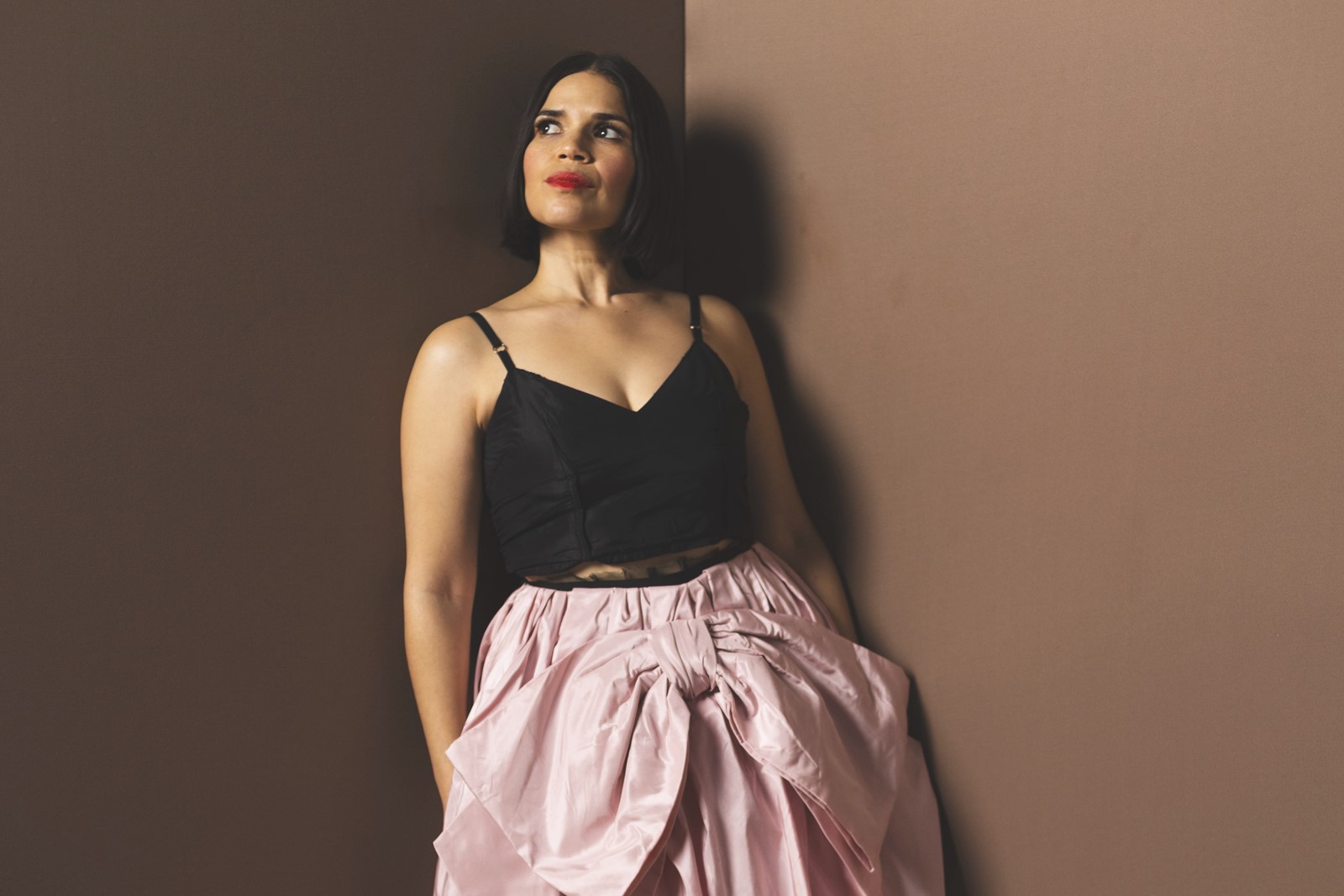


Oscar nominee America Ferrera, in many “Barbie” fans’ minds, is the heart and soul of last summer’s blockbuster. As Gloria, a mom who’s struggling to connect with her daughter, she sets the “Barbie” story in motion.
It’s a powerful performance that pops from the cotton-candy backdrop of the film, which is up for eight Oscars, including best picture. The Times spoke with Ferrera for our Envelope video podcast as the reality of her supporting actress nomination was still sinking in fully.
“Yesterday, I was at an event where it was the first time they introduced me as ‘Academy Award nominee America,’ And I was like, ‘Oh, my God. It’s so weird,’ ” Ferrera said, joking, “My children have to call me Oscar nominee from now on.”
The following conversation has been edited for length.
No. Well, my son, who’s the older one, he’s 5, almost 6. He’s asking, “Why are you getting so many flowers? Why are all the flowers for you?” Ryan [Piers Williams], my husband, started explaining and I was like, “Don’t. He doesn’t need to. Something happy happened to Momma.”
When I started out, I had this assumption that you do one good thing and then [Martin] Scorsese, he’s knocking on your door, the directors are going to come. And that’s not [always been true.] I’ve had incredible successes and still, to get to work with feature film auteur directors on a studio film level, and then also finding the right version of that [where] I can shine in that room or it’s utilizing the best of me, it seems unlikely. I’ve only just in my career begun to be considered for roles outside of Latino roles. Almost every role I’ve ever been offered was specifically written for a Latina. They had to find a Latina, and so I could be considered for that. But outside of that, I had a really hard time being considered for roles that weren’t specifically written Latina. And so I think that seemed less and less likely as my career went on and I continued acting in things that I didn’t produce. But I continued producing and trying to create opportunities not just for the kinds of things I would love to act in but that would create more opportunity for more Latino talent. I started creating the kinds of roles that I would want to see out there for our community to step into. In a way, it was, “I’ll go over here and do this and not be expecting anything.” And then to have [“Barbie” writer-director] Greta Gerwig call, who I’ve admired for so long and have been such a fan of from “Frances Ha” and onward ... to get that call that she had written this part with me in mind and wanted it to be me, it was really super unexpected. And yeah, it really has given me an opportunity in feature films that is unprecedented for me.
Because it was [during last year’s actors’] strike, we couldn’t do anything. I wasn’t working the way I would be or engaging with audiences in person. And so there was nothing to do but be like, “What do you all think?” And I’m just sitting there reading, and to me, it was such a sign of success. I think if you make something that doesn’t cause conversation or controversy, it’s OK. But to make something that people are responding to on such a global level, it feels that you’ve done a thing, you’ve made art, you’ve started a conversation — when some people love it and some people hate it, and it’s too much this here, but over there, it’s not enough of that. And I think in a way, which is what I felt when I first read the script, it’s a piece of work like this shows us to ourselves. It shows us where we are in the conversation. One of the most fascinating things I learned was, I ran into the princess/ambassador to the U.S. from Saudi Arabia at an event and she said, “I wanted you to know that in Saudi Arabia, we got our first movie theater in 2018, one movie theater, and ‘Barbie’ had been banned in multiple neighboring countries. For four weeks straight, we had people pouring over the border to watch ‘Barbie’ at our one movie theater. And there was not an empty seat for weeks on end.” Here’s a movie that in one part of the world had been banned, that people had to cross borders to get to [it]. They wanted to be a part of this conversation or see what it was. And in another part of the world, the conversation was “Well, this is Feminism 101, or it’s not feminist enough.” So that’s fascinating to me. I don’t think the goal of art should ever be to make everyone happy. What’s exciting about it, what thrilled me when I read the script, was “This is a point of view, and this is saying something and it has the courage to do that.” So I was thrilled by the many conversations it’s sparked and is continuing to spark.
They had never been in a movie theater. My children are now in a 3,000-seat theater watching their mom. So I was like, “Am I traumatizing them? Am I helping them?” We had moved to London, and they visited me on set. I was traveling to do press for “Barbie,” so I wanted them to understand what it was: “Here is the thing that we made. Mommy made it. That you had helped me make and Daddy too, obviously.” And so I wanted it to be something that solidified for them, the thing that we all did together. Having them there felt like I was seeing it through their eyes. What are they responding to? And that’s exciting too. And what are they going to do when Daddy comes out? And they were stone faced the whole time. But that scene in particular, which was hard for me to watch, we’d done that scene a million times. So for me, it was also taking in what were the moments and the takes that Greta picked and how did it come together? And like anybody having to listen to their voice on a voice mail, trying to get past the criticism of myself. But that day, having my children there, trying to see it all through their eyes, it did land different, and I felt I could hear the words. And also, we were among 3,000 very friendly audience members and hearing that was the first time I’d seen it with an audience. And so receiving their applause and cheers, it was like “OK, I guess it’s landing.” That was a special experience.
For me, that was the excitement and the real gift of getting to play Gloria, that she was both a character who had this childlike wonder and could suspend her disbelief to play with Barbies and then believe that Barbie came into the real world and is taking her to Barbie Land. And she has this innate, childlike wonder and awe and desire to lose herself in adventure and be inspired by it. And at the same time, she’s a very real woman, who has experienced disappointment and frustration and heartache and this push and pull of her relationship with her daughter and what she’s losing in this moment as her daughter’s pulling away and what’s not happening for her in her job. Her disillusionment, her disenchantment leading her to grasp, to reinvent her world. And at first, I was confused by how is this woman who’s so real and disappointed and has to deliver this monologue and understands all this stuff about womanhood is also the woman who believes Barbie came for her? And the reality was that the journey was to give her and myself the permission to be all of those things which we are to maintain a childlike wonder and quality and a seeking out of joy and inspiration. At the same time that we are real women who know the real world and can hold both the disappointment of it and the wonder and awe and inspiration in it. And it was reconciling those two things within this one character that I think made her the most human.
Do I play with Barbie dolls now?
Yeah, I definitely look at Barbie differently. I have a 5-year-old niece who owns 82 Barbies, and she has all of them. Every color, every shape, every size. The wheelchair Barbie, prosthetic leg Barbie, she has all of the Barbies. And I watched her play with them. And what I see is she’s just telling herself stories all day and she’s playing them out. And I think the beautiful thing is now there is more possibility in that world because there are more realities represented. And I think that because I didn’t play with Barbies, I just wasn’t tapped into what people loved about them. And now having met so many people and watching my niece, realizing, “Oh, this is a tool that young people use to express the world they see around them, and not all kids are drawn to it.” But I do, in a way, think that child’s play is sacred. And that is something to protect and to make better for our children ... And also, I feel child’s play is something to protect, inside of ourselves, particularly as women. As we grow older, so much caretaking and responsibility and having to be so many things all at once takes hold. Where are the places in our adult lives that we get to stay connected to joy and the things we loved as young girls?
Well, “Mexican Daughter” has been an adaptation that I’ve been a part of since 2019. So it’s been almost five years of setting this project up, developing it. And I knew I had that in the works when I went to go do “Barbie.” And Greta was incredibly gracious and just said to me, “I want you to be anywhere you want to be.” And so she let me sit in on her and [cinematographer] Rodrigo Prieto shot-listing. I sat in visual effects meetings getting to learn and hear about levels of technology that are so above my budget range. But she was so generous and just watching her operate, watching the way she was on set and how fiercely she protected the creative space and process with all of the pressure of a massive budget film with so much expectation. She was so present and and protective of each moment ... I learned from watching her be the director who was incredibly loyal to every single moment and making sure that we were finding the best version of whatever we were doing.
