


How design plays in childhood
Alexandra Lange explores the material influences on kids’ development, from building blocks to schools



Caroline Pratt — she started the City and Country School [in New York City in the early 1900s] and she was valued in her day. Pratt created the block that most of us use as kids, the unit block. It’s made of blond wood and shaped like a brick. If we’re talking about influential designers, we should talk about her.
And there was Patty Smith Hill who realized that if you make blocks bigger, you make them more social — it requires more children to move them. They were used for outdoor play and collaborative play. A lot of these things were developed by women educators. If you change your lens, you realize they were important women designers. We just didn’t call them that.
That was somewhat of a slippery topic. I ended up turning to Parents magazine. It was started in the 1920s and had a column titled “Homes Mothers Want.” Their focus was on the most contemporary version of the home they thought their readership would want — and you can trace the difference in the importance of the way those houses changed.
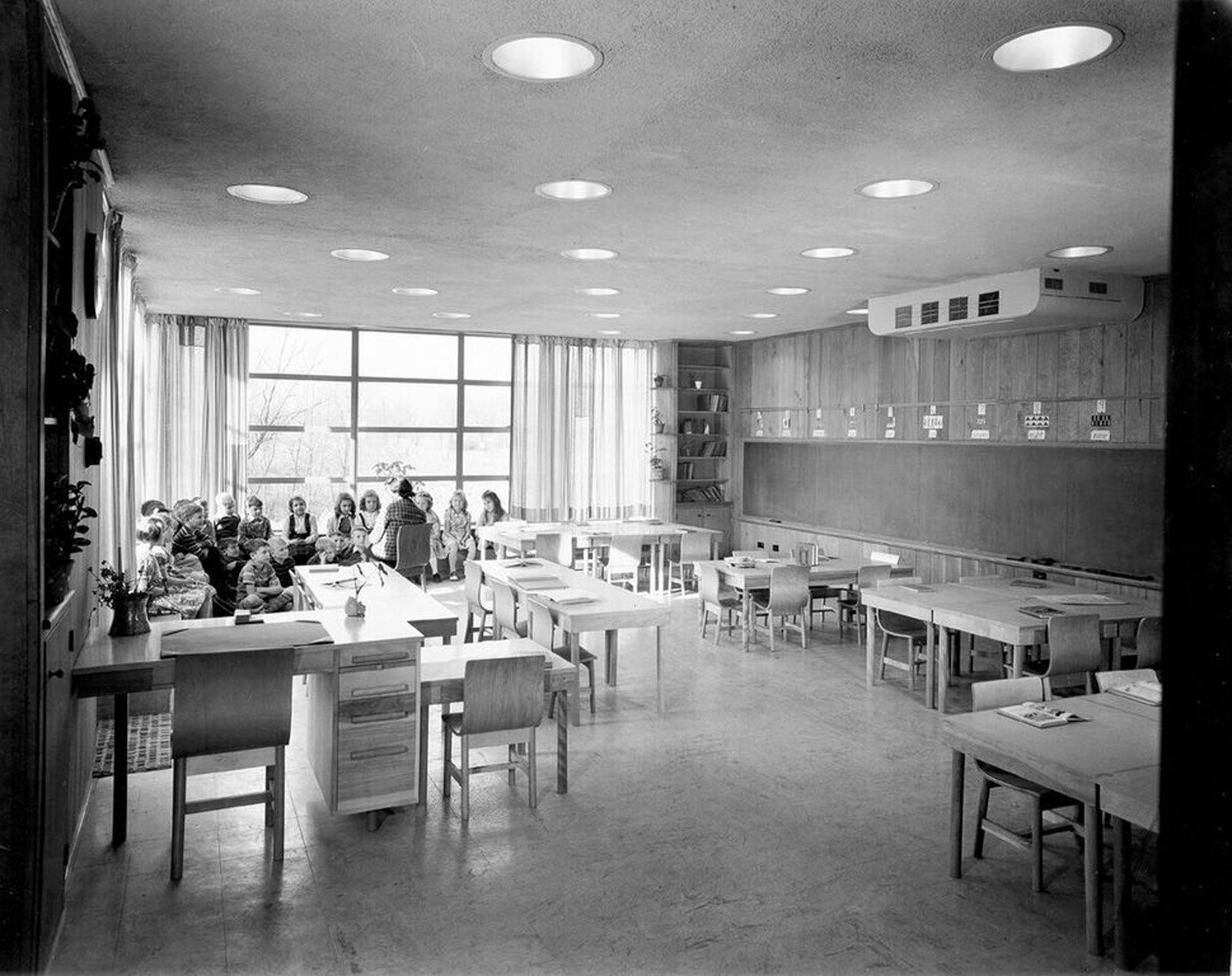
The big difference is children having their own rooms and playrooms. In the 19th century, children might have slept in their parents’ room or in the attic. They didn’t have things purchased specifically for them. But in the 1920s, that starts to change — you start to see child-sized furniture. Then after World War II, there is a huge building boom and they are building houses from scratch that have play rooms or play areas. Children’s spaces start to be thought of as a necessity.
But a lot of what we are talking about is ideal situations that were more available to white families than for minority families and they are economically indexed.
They were a program started by Booker T. Washington and Julius Rosenwald [a philanthropist and part owner of Sears, Roebuck & Co.] in the early 20th century in the South. At the time, white children were pretty much going to school, at least elementary education. That was not available to black children. So the idea was that the Rosenwald Schools program would cover part of the cost to build schools and they’d provide architectural patterns to build them. Some of the budget would have to come from the fundraising from the black community. So white schools were public schools and they were free. Black people had to build their own schools.
The look of the schools was purposely kept simple so that they wouldn’t look better than the white schools. In the book, I talk about this incident where Frank Lloyd Wright was asked to design a Rosenwald School, but it ended up being too fancy.
The National Trust for Historic Preservation has an initiative to preserve some of the surviving Rosenwald Schools. But what you need is a Rosenwald School trail. The scale of it is important. They built 5,000. [About 800 remain.]
There is a school in Queens that is a giant circle. And the classes were supposed to be arrayed around the circle, with low walls between them. At the center, there was a library, up some steps. But the library didn’t have walls, and you could hear
They were bad. Open-plan schools were a failure of architecture. But there were elements of them that tried to approach a different idea of education that was good and progressive.
A junk playground can mean a lot of things: It’s an empty lot, preferably in an urban area, and it’s filled with junk. That junk can be cardboard boxes or broken exercise bicycles or construction refuse. The important part is that it’s loose and that children can decide for themselves if they want to dig a hole or build a swing with a rope. The idea is they build their own play. In Japan, I visited a junk playground and watched two girls climb on the roof of a hut and sing.
By making playgrounds this thing where all you can do is go up and down the slide, you’re making it boring. If you give them a pile of cardboard boxes, then they have agency. That’s why sand works so well. In a sand garden, one day the kids would pile all the dirt into a mountain. The next day they’d take the hose and make a water slide. The next day they’d be mucking about.
I don’t feel like I saw the perfect thing we should all copy. I saw bits of it we should extract from. What I have been saying to an American audience is that I think street redesigns are a really important place to start. If we want children to be more independent, the real threat to their lives is streets and cars. That’s not a fake fear — like your child being kidnapped — it’s a real fear.
It doesn’t matter how many nice amenities you have if you can’t get to them safely. If walking through your neighborhood is dangerous because everyone is moving too fast, dealing with the street is the first line. Children and families belong in cities and they deserve to have cities designed to protect them.
I would say that we are employing design for children as decor for adults. The bright colors and the bean bags, they are decor. It becomes wallpaper for tech companies to say, “We’re fun, we play, we get our ideas from this.” It’s not clear to me how much time anyone there has to play with this stuff. Ironically, we associate children with creativity even as we take opportunities for creativity out of their lives.
