


Ex-rivals vow to work together in Mexico
The incoming and outgoing presidents say they’ll cooperate on nation’s challenges.
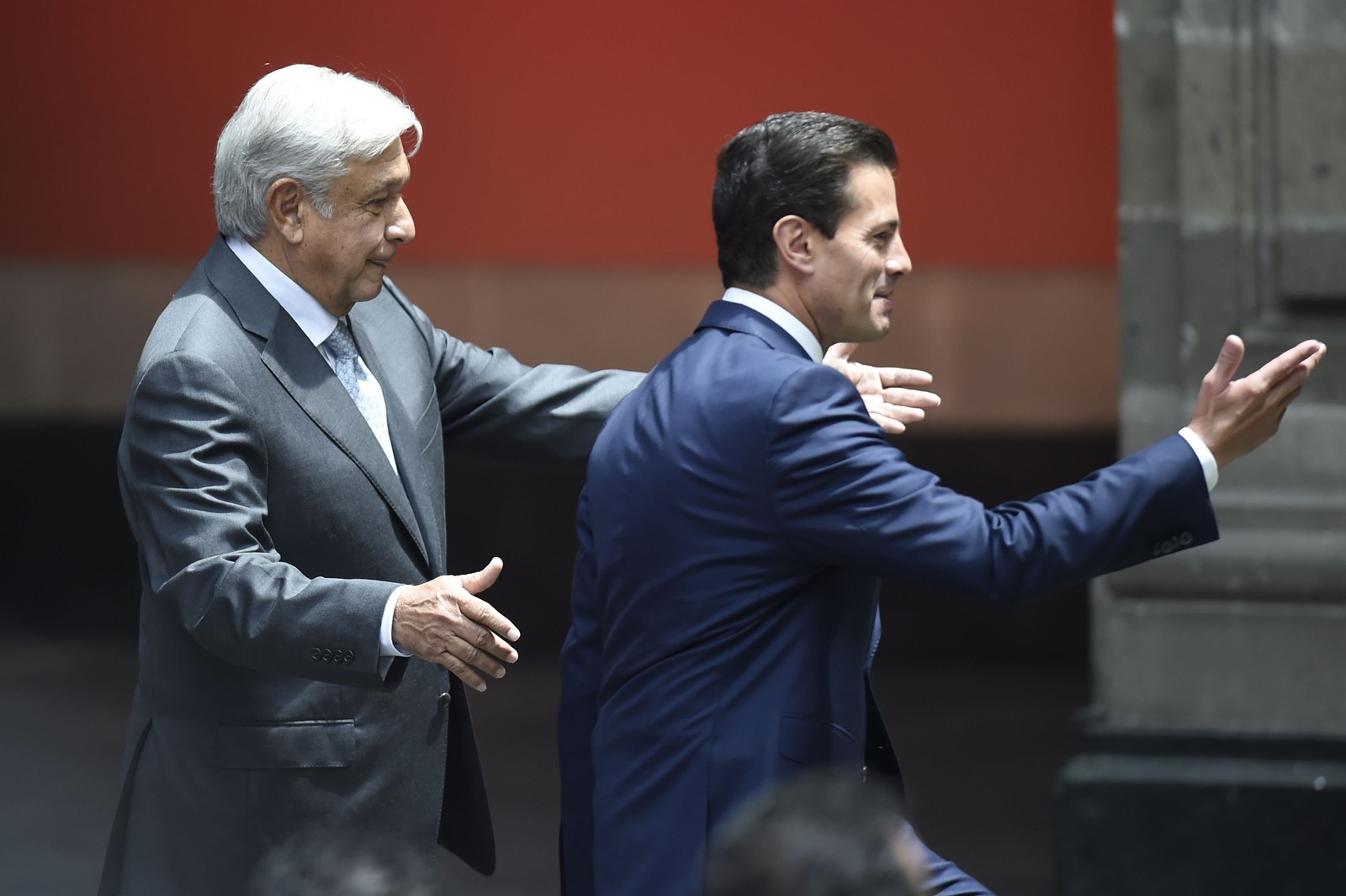


Peña Nieto and Lopez Obrador —
It was the latest in a series of gestures meant to demonstrate stability and continuity as the leftist Lopez Obrador prepares to assume power amid pledges for a far-reaching “transformation” of Mexican society. Peña Nieto has faced widespread unpopularity and the perception that he has been an ineffective leader.
“It is an institutional transition but it is also a respectful transition because we have received help without conditions from the constitutional president, Enrique Peña Nieto,” said Lopez Obrador, who won the presidency after losing in the two previous national elections, in 2012 and 2006.
Peña Nieto, in turn, vowed to do all he could to ensure that “the next government begins its term in a successful fashion.”
Lopez Obrador, elected July 1 in a landslide, is scheduled to take office Dec. 1 for a single six-year term. Peña Nieto was not a candidate in the balloting as Mexican law bars reelection of presidents.
The two men Monday answered half a dozen questions from the press but didn’t veer from differences on a number of contentious issues — notably national education reform and a planned new multibillion-dollar airport for Mexico City.
Lopez Obrador reiterated his vow to review the controversial airport plan — critics say it is too expensive and not needed — and to rescind the current administration’s education overhaul blueprint. The president-elect has said he will seek out views from all sectors on how to improve the nation’s moribund public education system and what to do about the airport proposal.
Education reform was a centerpiece of Peña
Lopez Obrador and Peña
Despite many preelection fears of an economic slide after a Lopez Obrador victory, Mexico’s economy has remained stable and the peso has retained its value against the U.S. dollar and other currencies. The incoming president has vowed to revitalize the sluggish Mexican economy, but has provided few specifics beyond a broad anti-corruption push.
Since election day, Lopez Obrador has generally toned down his often fiery rhetoric — he campaigned relentlessly against what he labeled the “mafia of power,” including Peña Nieto’s administration
The president-elect has also reached out to Washington and said he would invite President Trump to his inauguration.
U.S.-Mexico relations have experienced turbulence since Trump took office and repeatedly criticized Mexico and Mexicans.
Negotiations are continuing among the United States, Mexico and Canada in crafting a new North American Free Trade Agreement, the three-nation accord that has governed commerce on the continent for almost a quarter of a century. Trump has assailed the pact as unfair to U.S. interests.
The free-trade regimen is a cornerstone of the Mexican economy. Almost 80% of the nation’s exports go to the United States. Peña Nieto and Lopez Obrador have voiced support for a new trade accord.
Lopez Obrador, who ran on a leftist populist campaign vowing fundamental change, won 53% of the vote, defeating his nearest challenger by more than 30 percentage points. He has vowed to increase social-welfare payments to the poor, make higher education available to all and eliminate deep-rooted corruption.
Lopez Obrador will be the first in the nation to take presidential office with a majority vote since 1988, during the days of dominance by Mexico’s Institutional Revolutionary Party, known as the PRI.
The PRI’s more than seven-decade hold on the presidency ended in 2000, with the election of Vicente Fox of the right-of-center National Action Party. But Lopez Obrador is the first avowed leftist and first contender from a nontraditional party to be elected president in the 21st century.
Peña Nieto is the current standard-bearer for the PRI, which suffered a humiliating defeat in the July 1 elections.
Lopez Obrador is among a number of left-leaning politicians who abandoned the PRI starting in the late 1980s. Lopez Obrador ran under the banner of his party, the National Regeneration Movement, or Morena.
Morena not only won the presidency, but also garnered major majorities in both chambers of the national legislature.
Despite his party’s newfound dominance at the federal level, Lopez Obrador has repeatedly vowed to reach out to all sectors.
“This government is going to represent all Mexicans,” Lopez Obrador said Monday. “No one will be on the margins of the law or above the law.”
