


BOILING POINT
Charging stations in disrepair
Broken units, payment problems,
cables that don’t reach: The long road ahead for the power network build-out



But the public charging system for electric cars? Not a fan.
I recently piloted a Ford F-150 Lightning EV from my Berkeley home down Interstate 5 to Long Beach, a 400-mile trip. The truck? Great. The charging experience? Miserable.
The misery was meted out in several ways. Charging stations were hard to find. Maps that locate stations were not reliable. Paying for a charge with a credit card often proved troublesome, sometimes impossible. Worst of all, way too many chargers were broken or otherwise out of order. (“Unavailable” is the preferred industry euphemism.)
Running low on juice at the foot of the Grapevine, for example, I found a ChargePoint station off Interstate 5 at Frazier Mountain Park Road. The station comprised two chargers on the far weedy fringes of a nearly empty Jack in the Box parking lot. Only one was what’s called a DC fast charger.
The fast charger wasn’t working. Its digital readout said “unavailable.”
I called the toll-free customer service number. Yep, the charger was unavailable. Why? Not sure.
The other charger, unoccupied, was the more common, slow-charging variety. I plugged in, eschewed Jack in the Box in favor of a sandwich at Subway, waited an hour and 15 minutes. In that time, I’d added nine miles of range. Pathetic, yes, but nine was enough to make it down Interstate 5 to where I found a ChargePoint fast charger that worked.
A charger that is operating properly should not provoke so much joy.
Billions of dollars in state and federal subsidies will soon be pouring down on the EV charging industry. Over time, millions of public chargers are to be installed — more than a million in California alone. Great for EV owners. The more public chargers, the better.
But numbers won’t be enough. If the reliability of those chargers doesn’t improve — and dramatically — California may well encounter a public backlash against the mandate that all new cars starting in 2035 must be electric.
My Interstate 5 experience was not a run of bad luck. I’ve had similar problems with public chargers back home.
A study of San Francisco Bay Area charging reliability led by a researcher at UC Berkeley and released earlier this year found that of 657 chargers, 23% were out of order and an additional 5% were fitted with a cable that couldn’t reach a car. Of the three biggest vendors, ChargePoint was the worst (with 36% not working), followed by EVgo (25%)and Electrify America (19%).
The poor record is reflected in surveys. A Plug In America poll in 2021 found that 34% of EV owners surveyed reported problems with public chargers, with broken fast chargers the most common concern.
Another, published in August by market researcher J.D. Power, found that 20% of respondents showed up at a public station and did not charge up; of those, 72% said the station was out of service. Those poor numbers are worse this year than last, despite — or perhaps because of — the growth in new charging stations.
My experiences on the trip illustrate the frustration.
I found plexiglass screens placed over ChargePoint touch screens throughout Long Beach that rendered a credit card purchase impossible. I ran across a Rivian driver who spent 15 minutes on the phone with Electrify America to get his app to work with the charger.
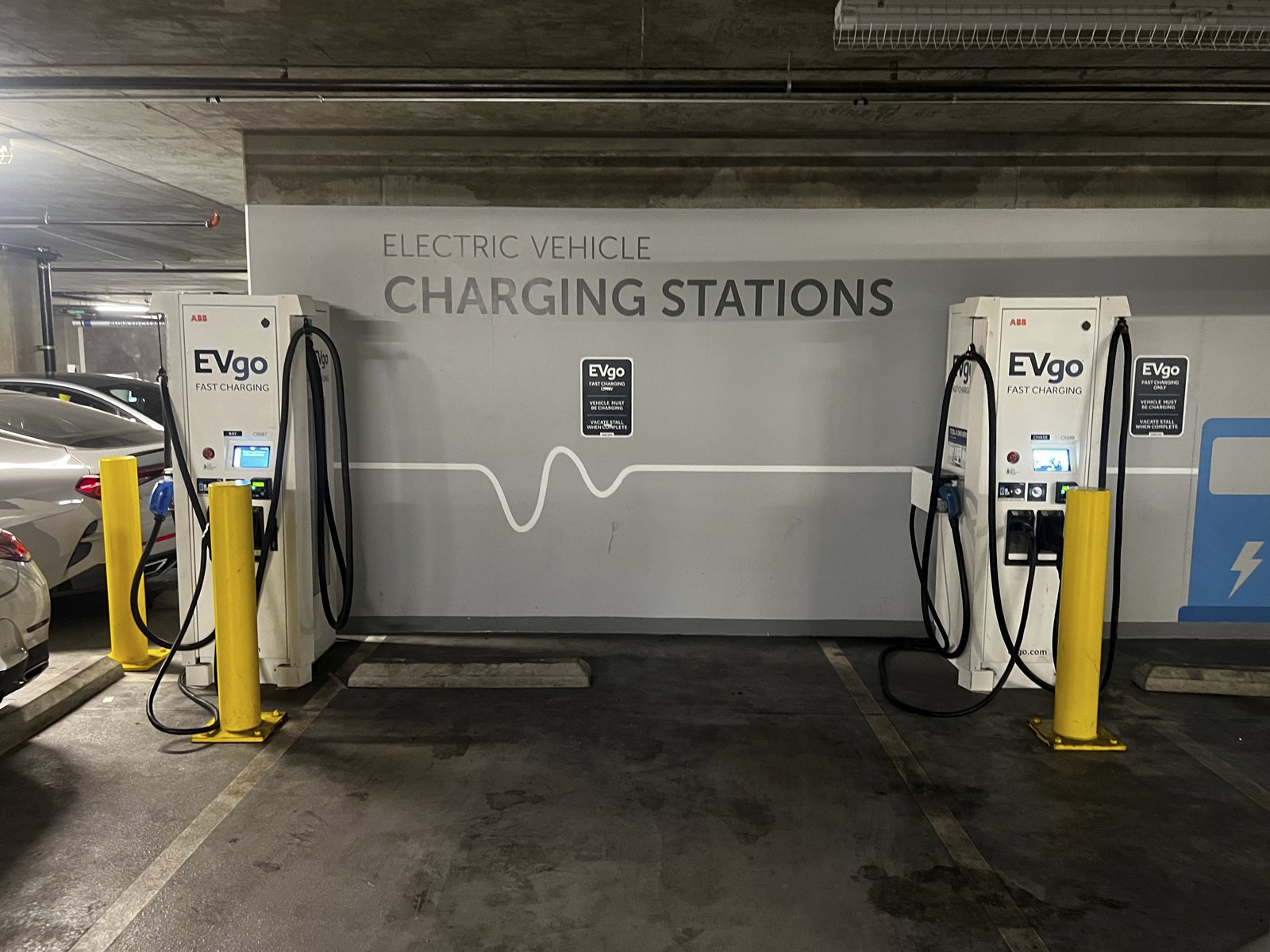
I found supposedly public chargers in buildings with no public access, including one up the ramp of a Long Beach apartment building with the entrance marked “Residential parking only.” Neither of the two EVgo chargers were working. One was marked “unavailable.” The other wouldn’t charge after I plugged it into my vehicle. The person on the toll-free EVgo line didn’t know why and said she’d help find another location.
Why are public chargers so unreliable?
One reason: Responsibility for service and maintenance is diffuse. Installing and operating a charging station involves a mix of players. The manufacturer. The marketer. The installer. The site owner — often retailers that include Whole Foods, as well as individual mini-mart owners. The electric utility. The internet provider. The credit card company.
The marketers — think EVgo, Electrify America, ChargePoint — might be responsible for service and maintenance, or they might not. In ChargePoint’s business model, machines are sold to site owners, who assume the responsibility to keep them in working order.
Here, I must note that Tesla has built a vast network of fast and reliable chargers.
It cost Tesla a lot of money to do this, cash that Chief Executive Elon Musk raised through means sketchy or not: selling huge numbers of cars; boosting Tesla’s stock price with false promises about future products; selling features like “Full Self Driving,” which aren’t full self-driving, for $15,000.
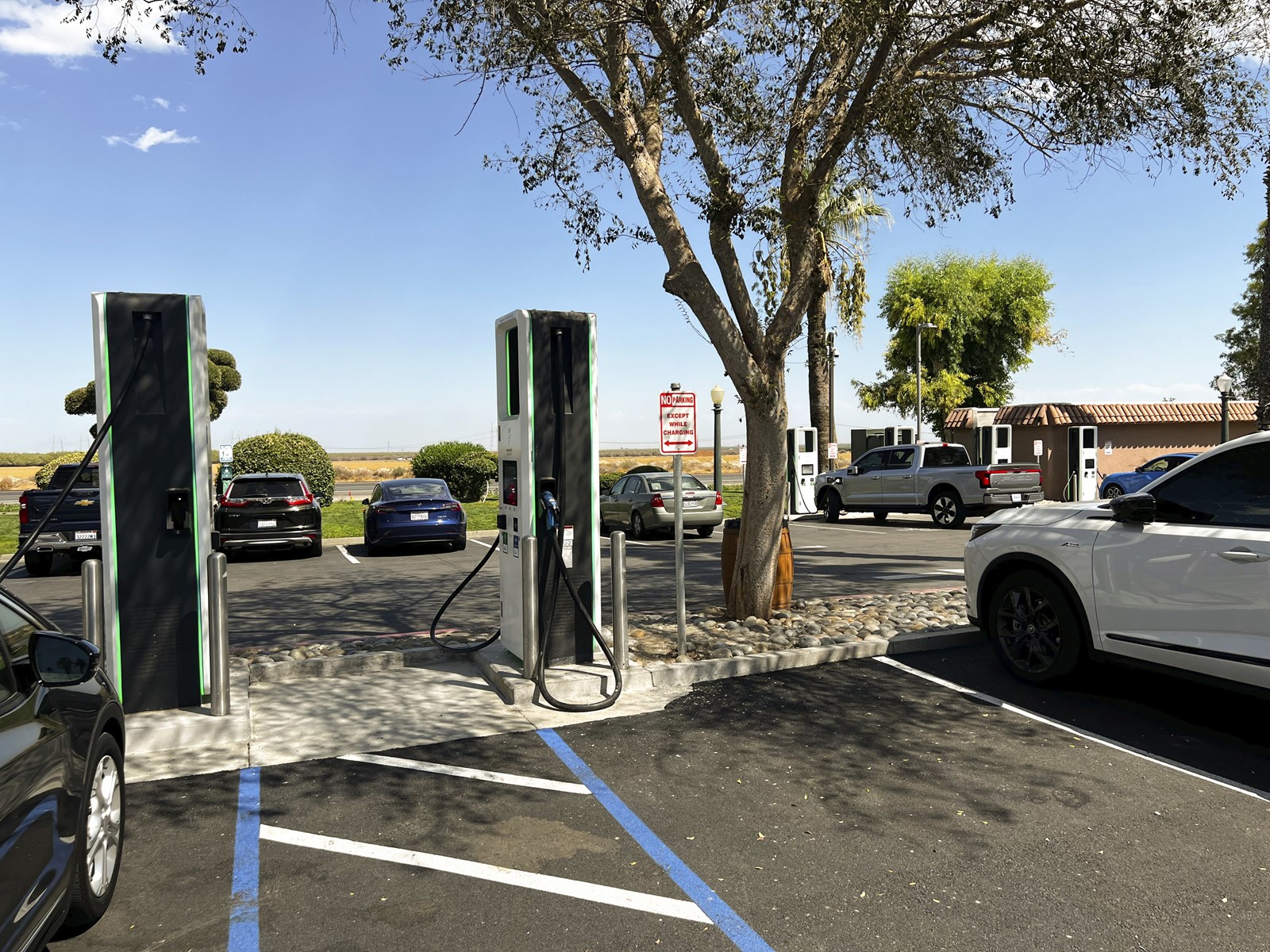
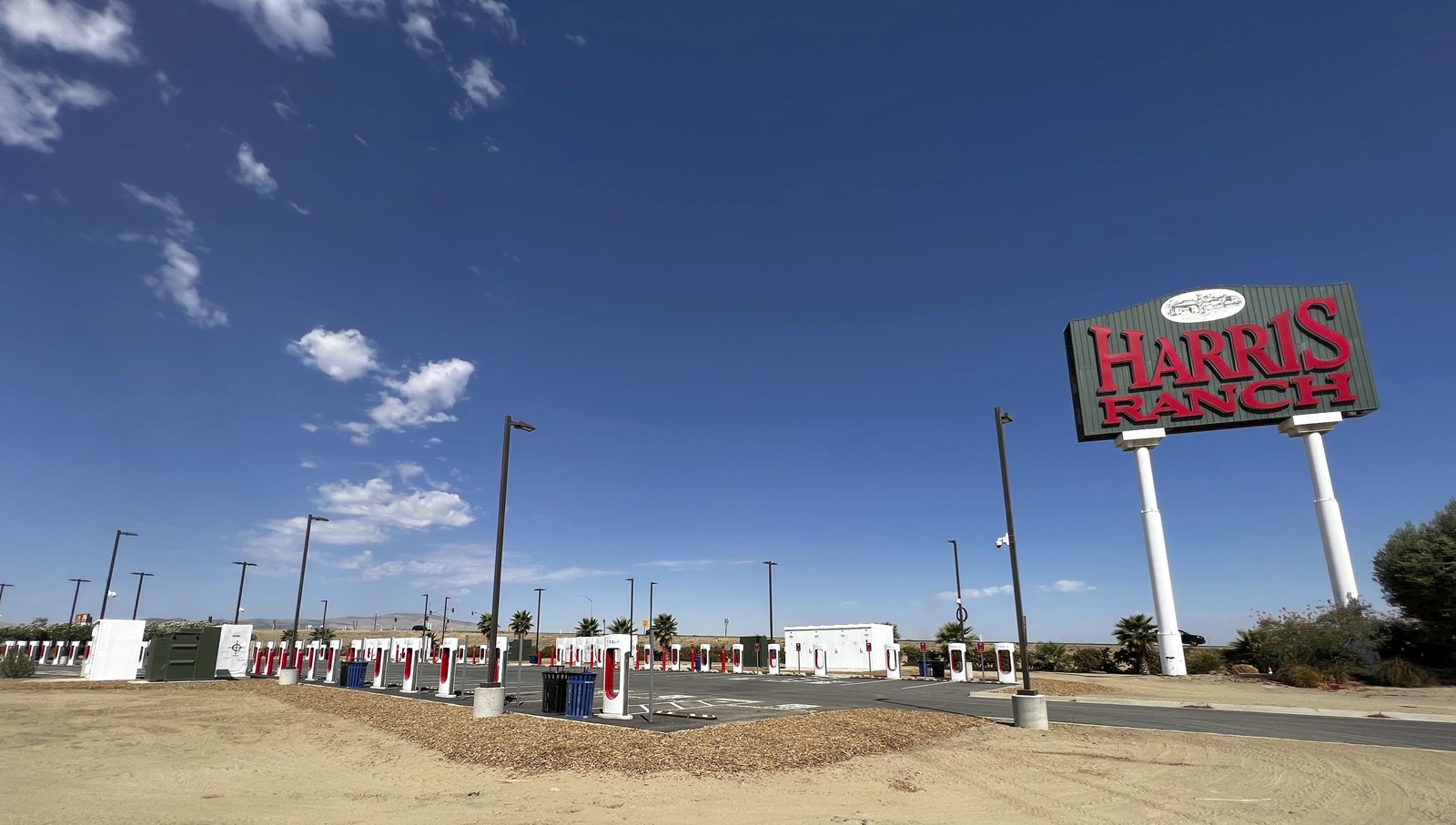
Drive into Harris Ranch Inn & Restaurant near Coalinga on Interstate 5, and the Tesla difference becomes clear. There are 80 newly installed chargers soon to go into operation. There are clearly visible road signs that use arrows to easily direct drivers to the 18 chargers, located in another area, that are open and available.
For those with electric cars not named Tesla, you can search for six Electrify America public chargers in two spots in the hotel-restaurant’s parking lot. The day I was there, one charger was unavailable.
Electrify America has more true fast chargers than the competition. The network gets some of its funding — hundreds of millions of dollars — from Volkswagen, part of the carmaker’s penalty after its cheating ways on diesel emissions were revealed in 2015.
Other charger companies are funded by venture capital or have gone public through special purpose acquisition companies. One of them, Greenlots, was recently bought by Shell. All are under pressure to show profits in a business in which it’s unclear where charging profits will come from sans subsidies.
Both the federal government and California will require the recipients of billions of dollars in grants and other subsidies to maintain stations with 97% reliability. But it’s unclear thus far how company performance will be determined.
Gov. Gavin Newsom recently signed a bill to require information collection, and the state says it’s studying the issue. There’s been little to no discussion about how that 97% figure will be enforced.
The Bay Area study noted that although only 75% of public chargers were operable, the companies were reporting 95% to 98% uptime to the California Air Resources Board. The study’s methodology could account for the difference, but 20 percentage points is quite wide.
I called the three big EV charger companies to ask about the reliability problems and what they’re doing to solve them.
Anne Smart, head of global policy at ChargePoint, said reliability is improving. The company looks at comment sections online, and “we see quite a trend in statements that when drivers go to these stations, they are up, they are usable.”
She noted that the
Asked what ChargePointis doing to reach such high levels of reliability, she said the majority of the company’s public chargers are independently owned and operated.
“The site hosts are critical,” she said. “We provide maintenance services to help the owners keep the equipment running. … We provide a free app to locate the stations, and we can receive communications from the driver when a station is not working.”
She advised ChargePoint customers to use the company’s app for payments or use the contactless chip reader on many of the chargers. Sometimes the credit card readers don’t work because they’ve been exposed to “dust or wildfire particulates,” she said.
Electrify America acknowledged that reliability is a serious issue and detailed the ways the company is addressing it.
“There are problem spots, and we recognize it,” said Rob Barrosa, head of business development. “It’s all about what you are going to do as a company to stand behind your performance.”
Five years ago, the company built a “center of excellence,” where, he said, “we test every electric vehicle you can imagine” to identify potential problems from the start.
The company also maintains a network operations center. In addition to trying to keep things running, it collects and analyzes data on charger performance.
“We’re looking at hundreds of thousands
Electrify America puts at least three chargers at each station. The average, it says, is five, and in some places as many
as 20.
“Redundancy is important,” Barrosa said. If you put a single charger somewhere, and it doesn’t work, “that doesn’t instill a lot of confidence.”
The company is pressing its charger manufacturers to improve quality, he said, noting that it has “actually tried to take ownership of the technology” and dump suppliers who can’t keep up.
Additionally, the company has a roaming fleet of “secret shoppers” who drive around in EVs to test the company’s equipment.
“We are doing everything we can to stay ahead,” he said. “You have to keep upping the bar over and over again.”
EVgo likewise copped to the problem, although Chief Commercial Officer Jonathan Levy felt obliged to say, “I tell people the state of charging is better than people think.”
But, he added, “we have a lot of work to do to go from bleeding and leading edge” to mainstream experience.
The company has opened an “innovation lab” in El Segundo to test cars from all the manufacturers to make sure the public charger and electric vehicle play nice together.
EVgo, founded in 2010,
As with Electrify America, it’s building stations with more charging points, so a broken charger won’t necessarily spoil a car trip.
“We make money when chargers work,” he said. When they don’t, “we lose money, so we’re motivated to make the chargers work.”
If I were grading the public charger industry, I’d issue a harsh D+. At the parent-teacher conference, I’d say that Johnny is not living up to his potential. Let’s hope he applies himself.
