


Danish-settled tourist village has become a ghost town


He was leisurely riding down the center of an empty street in this California tourist haven that would be clogged with traffic under normal circumstances.
But these aren’t normal times.
With much of the country under stay-at-home orders to curb the spread of the novel coronavirus, the Danish-settled village, whose windmills and half-timbered architecture draw more than 1½ million visitors a year, is a virtual ghost town.
“I’ve never seen it like this,” said Stacy, a retired Episcopal preacher who has spent 53 of his 72 years in Solvang.
A couple of blocks away, Thomas Birkholm keeps his Danish bakery going by preparing takeout orders with a staff made up largely of family after he laid off 16 employees.
“Every day it’s like Christmas morning coming in here,” Birkholm said. “The streets are empty and everything’s closed.”
This is the equivalent of an economic earthquake for this tiny town of nearly 6,000 people nestled in the Santa Ynez Valley wine country, about a half hour north of Santa Barbara. Tourists are the engine of an economy than generates nearly $200 million a year. Hundreds in Solvang and the surrounding bedroom communities have already lost their jobs, while the city is losing $500,000 in tax revenue a month.
“That’s a lot of money to a town this size,” said Andrew Moore, whose wine-tasting room has shut down. “It’s a lot of money to a town of any size.”
On a typical spring weekend, just a handful of the city’s 847 hotel rooms would be empty and the lines to get into the wine-tasting rooms and restaurants would be long. This weekend, just a handful of the city’s hotels were even open, and the longest line was outside Bethania Lutheran Church, where people queued up for food donations.
Solvang began to feel the effects of the coronavirus pandemic March 15, when the Chumash Casino Resort in neighboring Santa Ynez closed. Four days later, the rest of the state shut down too, with Gov. Gavin Newsom ordering all nonessential businesses to shut down.
For a city that has endured floods, fires and economic downturns, the governor’s declaration was another painful blow.
“This is just on a totally different scale,” said Mayor Ryan Toussaint, who has lived here all his life. “There is no playbook for this.”
Toussaint, 33, said he is asked every day when things will go back to the way they were before, a question he can’t answer. But the new normal, he acknowledges, is not sustainable.
“People are kind of getting frustrated,” he said. “How long can they stay cooped up?”
Solvang’s majestic festival theater is among the city’s many closed businesses, the nonprofit having already postponed most of its summer season. The Rancheros Visitadores
As Toussaint walked the lonely streets of the city center, a boy did skateboard tricks in the empty parking lot of a hotel whose red neon No Vacancy sign meant closed. In front of the Copenhagen House, a retail marketplace, the statues of Solvang’s Danish founders have been outfitted with protective masks.
Bent Olsen, who opened a thriving bakery in Solvang five decades ago and did so well he bought the hotel across the street and invested in a restaurant downtown, has furloughed more than half of his staff. He likens the situation to the 1973 oil crisis, when gas rationing kept people from around Southern California, who account for 85% of Solvang’s visitors, off the roads.
But the hardship is relative, said Olsen, 76, who was born in Denmark in the waning days of World War II.
“After the war, that was not very good times,” said Olsen, whose bakery continues to sell pastries and coffee to go. “We kind of learned how to tighten our belt. You have to survive. That stuck with us for all those years.”
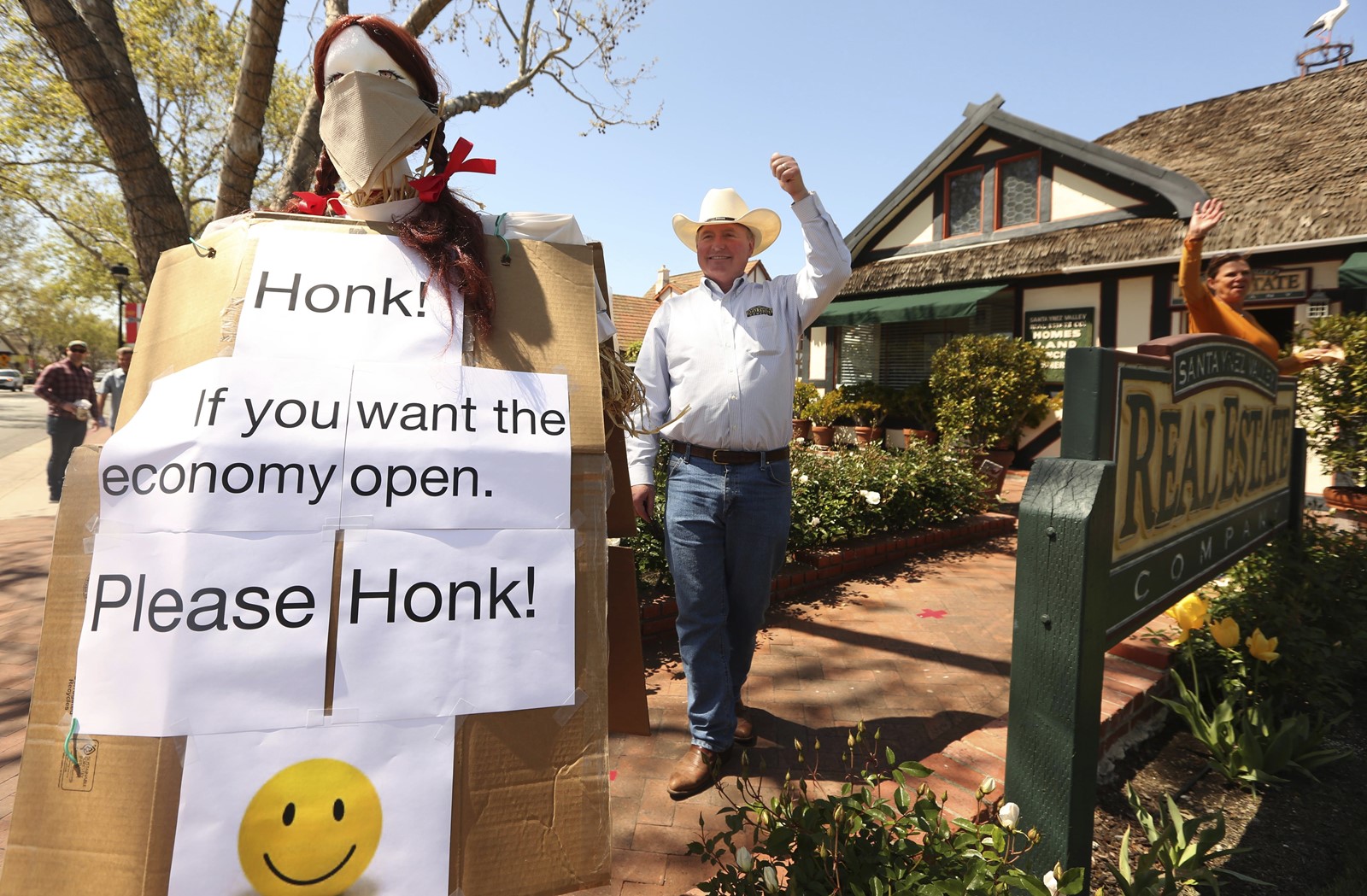
Not everyone is as stoic. About a quarter-mile down Mission Drive, the main road through town, Allan Jones has placed a sign in front of his real estate office asking passersby to honk if they want the shutdown to end.
So many obliged that the noise forced Jones to take the sign down.
