


Breaking ground with Kabul’s garbage
The first woman in Afghanistan to run
a recycling plant is driven by her wish to help the environment.
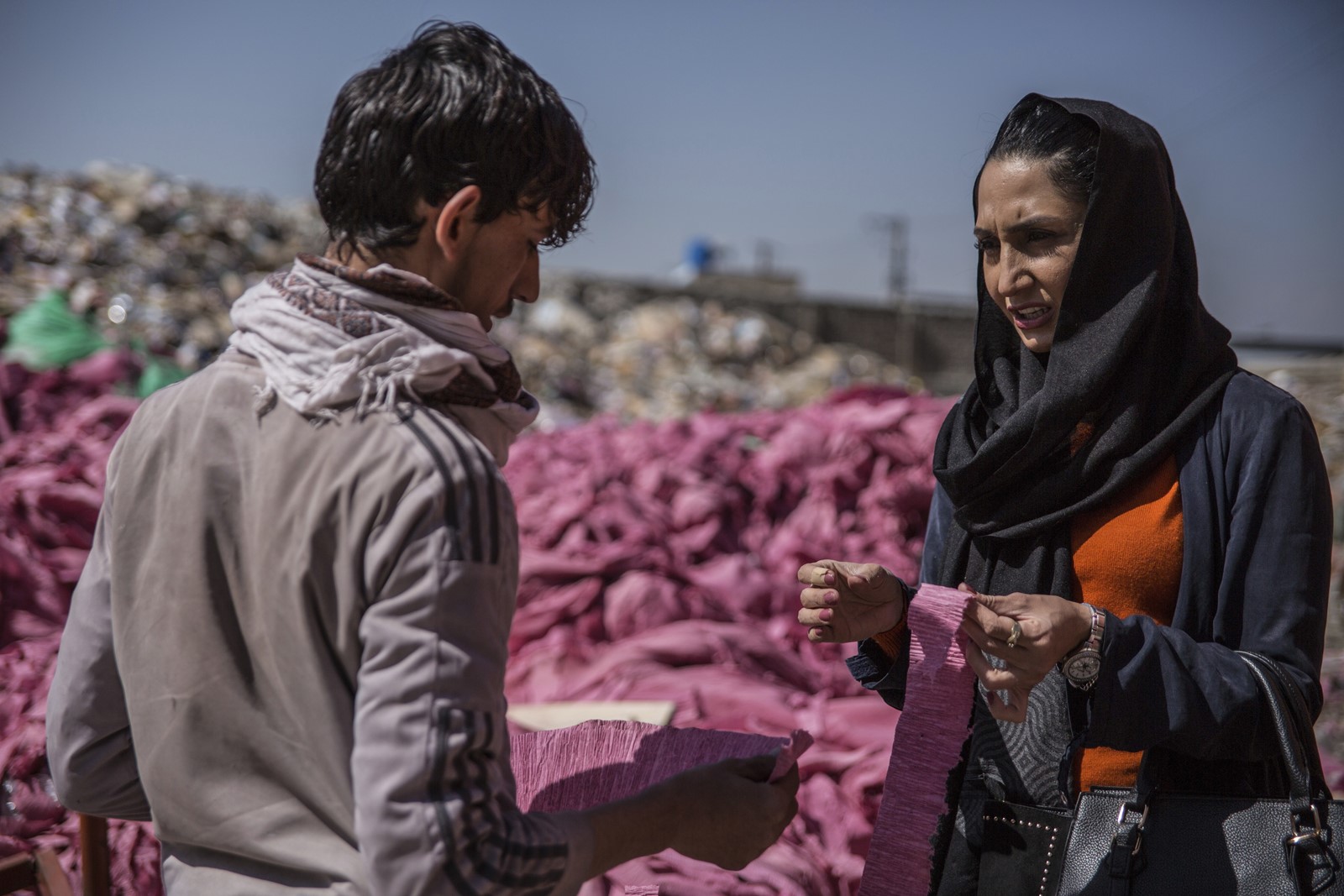


But now, one Kabul woman is declaring war on the Afghan capital’s trash.
Zuhal Atmar, 35, has set up a recycling plant where she processes 33 tons of garbage a week. She’s the first woman in Afghanistan to have launched such a business, often at a high personal cost.
Her drive, she said, stems from her wish to live “greener,” and from the realization that Kabul has been — at least in Afghanistan — contributing to a changing climate. “The city has one of the worst air pollution rates, and we toss away absurd quantities of one-time-use plastic,” Atmar said. “I had to change something.”
Running a business as a woman isn’t easy here. In Afghanistan, reputation is a lifeline when it comes to entrepreneurship, and Atmar is fighting for hers.
“People constantly threaten to destroy my business or my reputation,” she said. “I know a handful of men who run similar ventures and they are jealous. They don’t accept a woman doing the same.”
The mother of a 3-year-old, she lives in a modern high-rise overlooking the mountains that surround the capital. Her life is uncommon for a woman in Afghanistan; so is recycling.
Kabul’s 6 million people generate up to 308 tons of trash each day, according to the city. Most ends up in its only landfill, neither separated nor reused, guarded by 60 armed men protecting the machinery used to manage it, even as toxic waste slowly seeps into the ground. The trash heaps grow each day.
Atmar, who grew up as a refugee in Pakistan and returned to Afghanistan after the fall of the Taliban, has been in the trash business for seven years. She first set up a waste-management plant, separating the useful from the throwaways, but later decided to fully focus on recycling. She purchased $240,000 worth of Chinese machinery, a sum partly saved up from previous jobs but mostly donated by the U.S. government through the USAID program.
Located between mud brick houses on the far eastern outskirts of the city, her factory — surrounded by brick walls and a heavy gate — goes almost unnoticed from the outside.
Atmar focuses on paper waste, which she buys from scavengers. Trash collection is barely regulated in Kabul, and though there are 1,500 drop-off points, thousands of scavengers roam the streets daily, collecting items of value that are being tossed away.
Her staffers hand-sort the piles of paper and cardboard, singling out any plastic or perishables. The machines do the rest.
“Each ton costs 4,500 afghani,” or $57, she said. The paper is shredded, cleaned and bleached before it is dried and pressed into toilet paper that’s sold across the country.
The city targets about $14 million annually for waste management, which isn’t nearly enough, said Behzad Ghyasi, the municipality’s former director of sanitation services.
Atmar said her work deeply affects her personal life. Her business started off smoothly, but she quickly received death threats, and a handful of men who run similar businesses have teamed up to bring her down, she said.
Afghanistan has deeply rooted conservative beliefs, with women often seen as second-class citizens. She said there are five other factories like hers, all run by men.
“There’s a lot of judgment and many people are bothered by me running my own business,” she said. “It’s jealousy and wrong competition, and I think men here feel threatened. I might face more challenges as a woman, but it just means I have to fight harder. I’m not going to stay behind.”
Though the factory’s neighborhood has seen frequent terrorist attacks,
“Everyone needs to start feeling ownership for this city for things to improve,” Ghyasi said. Atmar, who gets up before sunrise each morning to manage both her household and her work, said she wants to set up additional recycling plants and advocacy campaigns to teach people how to produce less trash, and introduce paper bags to replace plastic ones.
“Kabul is environmentally unhealthy. Pollution is skyrocketing, especially in winter when coal is burned everywhere, and septic sewage contaminates our water. When it comes to the environment, we can’t wait for peace to come first. We need to act now,” she said, acknowledging that daily attacks across the country spread uncertainty and fear.
“I don’t see this changing anytime soon,” she said. “Some days there will be an attack, but soon after, we return to normal until the next attack. It’s a cycle. We have no choice but to still invest in our country and its environment.”
