


San Onofre nuclear plant to come down
Dismantling of the power station and its twin domes may start next month.
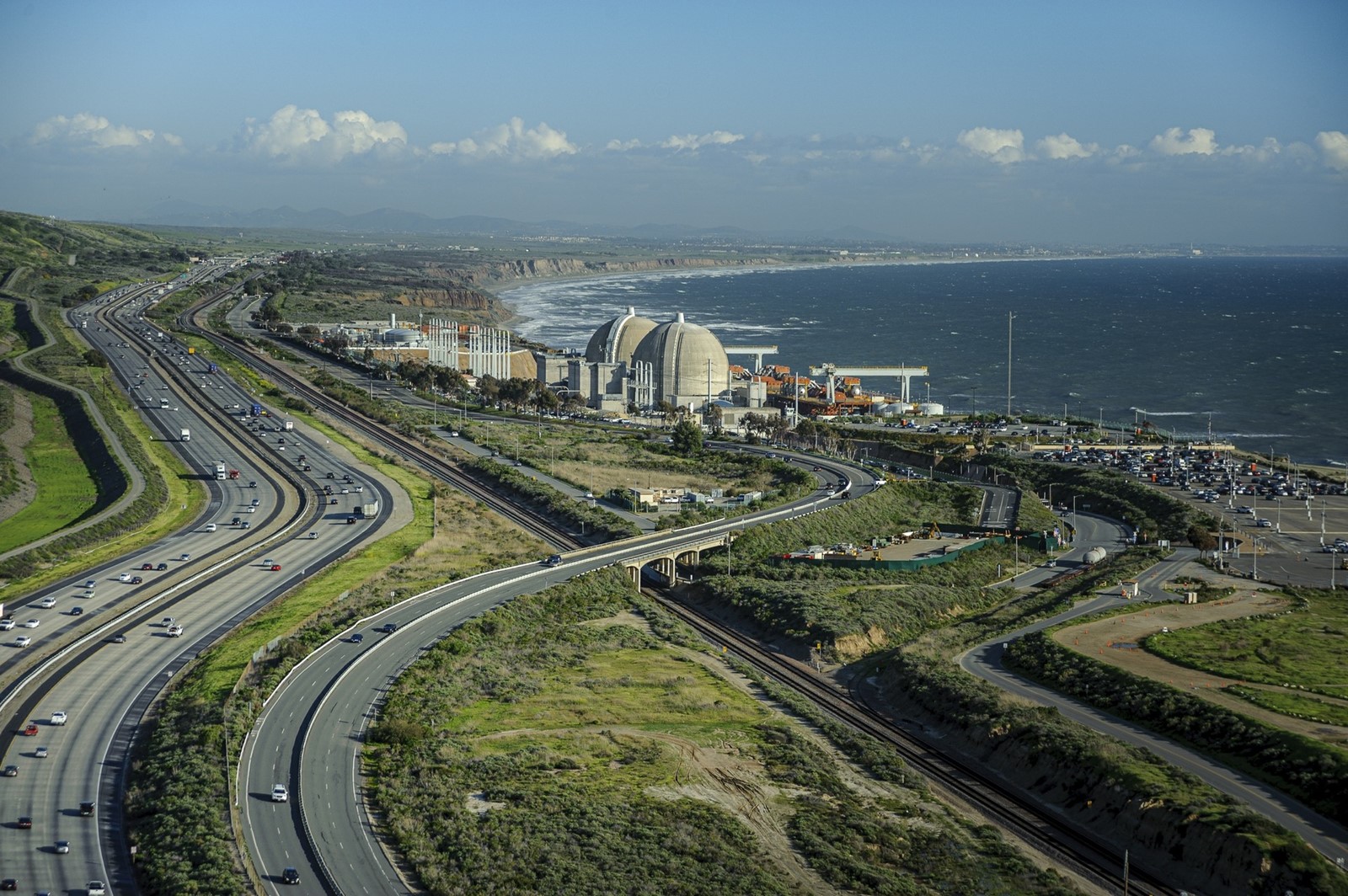


The plant’s operator, Southern California Edison, has mailed notices to about 12,000 residents in a five-mile radius of the plant that initial work will start no earlier than Feb. 22. The first jobs include erecting staging areas and temporary trailers in the plant’s parking lots and removing materials containing asbestos in the Units 2 and 3 domes.
By the time work is complete, all that will remain will be two dry-storage facilities housing canisters of used-up nuclear fuel from the days when the plant still produced electricity, a security building with personnel to look over the waste enclosed in casks, a seawall 28 to 30 feet high, a walkway connecting two beaches north and south of the plant and a switchyard with power lines.
A substation without transformers will stay put because it houses electricity infrastructure that provides a key interconnection for the region’s power grid.
Southern California Edison officials say they will expand rail capabilities on the site to reduce the use of trucks around the project in the hopes of reducing traffic congestion.
“To the extent possible, we’ll schedule and perform our work to minimize any inconveniences to you and your neighbors,” Doug Bauder, the chief nuclear officer at the plant, said in a notice sent last week.
The twin domes, rising 200 feet between Interstate 5 and the Pacific, are expected to come down in mid- to late 2025.
Away from the plant’s immediate footprint, the project will also get rid of offshore buoys and anchors and partially remove the large pipes that sucked in and then discharged ocean water in order to cool the plant.
The costs for the dismantlement will come from $4.4 billion in existing decommissioning trust funds. The money has been collected from the plant’s customers and invested in dedicated trusts. According to Edison, customers have contributed about one-third of the trust funds while the remaining two-thirds has come from returns on investments made by the company.
The work comes after Southern California Edison, or SCE, received approval to proceed last year from the State Lands Commission and then from the California Coastal Commission.
But the decisions were not without controversy. A number of critics of SCE’s management of the plant argued against granting the permits. One of their major concerns centered on the demolition of two spent-fuel pools where used-up nuclear waste goes to be cooled.
Although fuel inside a nuclear reactor typically loses its efficiency after about four to six years, it is still thermally hot and emits a great deal of radiation. To keep the fuel cool, nuclear plant operators place the used-up waste in a metal rack and lower it into a deep pool of water, typically for at least five years. Once cooled, the fuel is often transferred to a dry storage facility.
The Nuclear Regulatory Commission does not require operators to maintain the pools but many local environmental groups and critics of the plant say the wet storage option should remain.
The San Clemente-based Surfrider Foundation wants SCE to keep at least one spent fuel pool in place, or at least have a “readily deployable on-site repair device at the ready, in case a canister is damaged and needs to be retrieved.
“If canister integrity gets compromised in this coastal and corrosive environment, there needs to be a mechanism to repackage or repair it,” Mandy Sackett, Surfrider’s California policy coordinator, said in an email.
SCE officials say sending a damaged canister back to a pool poses more risks in terms of increased radiation dose to workers, potential radiation releases or damage to fuel rods than repairing the canister by using a metallic overlay or putting the canister into a licensed cask that can be transported.
“It would also be difficult to dismantle some of the structures and fully decommission the site if we had to maintain a working spent fuel pool,” SCE spokesman John Dobken told the Union-Tribune last fall.
In an agreement with the Coastal Commission, SCE has pledged to develop an inspection and maintenance plan for the canisters holding used-up fuel that goes into what is called a dry-storage facility at the plant. The company will also pay for an independent third party to review the plan, which will be forwarded to the commission’s staff.
By this July, the Coastal Commission is expected to consider a recommendation reached by its staff about whether to approve the plan. SCE cannot begin removing the spent-fuel pools until then.
Dismantling the pools is anticipated to start late next year and continue for several more years before work is completely finished.
Tons of contaminated steel and concrete from the plant will be shipped to various facilities in the West and buried.
Low-level radioactive waste will move via rail to a disposal site in the desert near Clive, Utah, and higher-level waste will be sent by rail or truck to a private storage facility in West Texas. Non-radiological waste will be trucked to a landfill in La Paz County, Ariz.
Although the plant has not been producing electricity for the last eight years, transfers of used-up fuel from the wet-storage pools to a newly constructed dry-storage facility at the plant continue. The first seven months of the dismantling will run at the same time that 50-ton canisters loaded with the waste are slowly moved using heavy equipment and eventually lowered into their respective storage cavities.
So far, 47 canisters have taken the trip to the north side of the plant, with 26 more coming. SCE officials expect to complete all the transfers by late this summer.
Dobken said until the transfers are completed, dismantlement work will focus on areas away from where the waste is being moved.
Originally licensed in 1967, San Onofre was carved out of an 85-acre chunk of Marine Corps Base Camp Pendleton, on property owned by the Department of the Navy.
Under the terms of the contract, SCE will maintain the property as long as the spent fuel remains on site. Once the waste finds another home, the property will be returned to the Navy.
