


Graciela Iturbide talks about going viral, L.A. cholos, shooting Frida Kahlo’s bathroom.
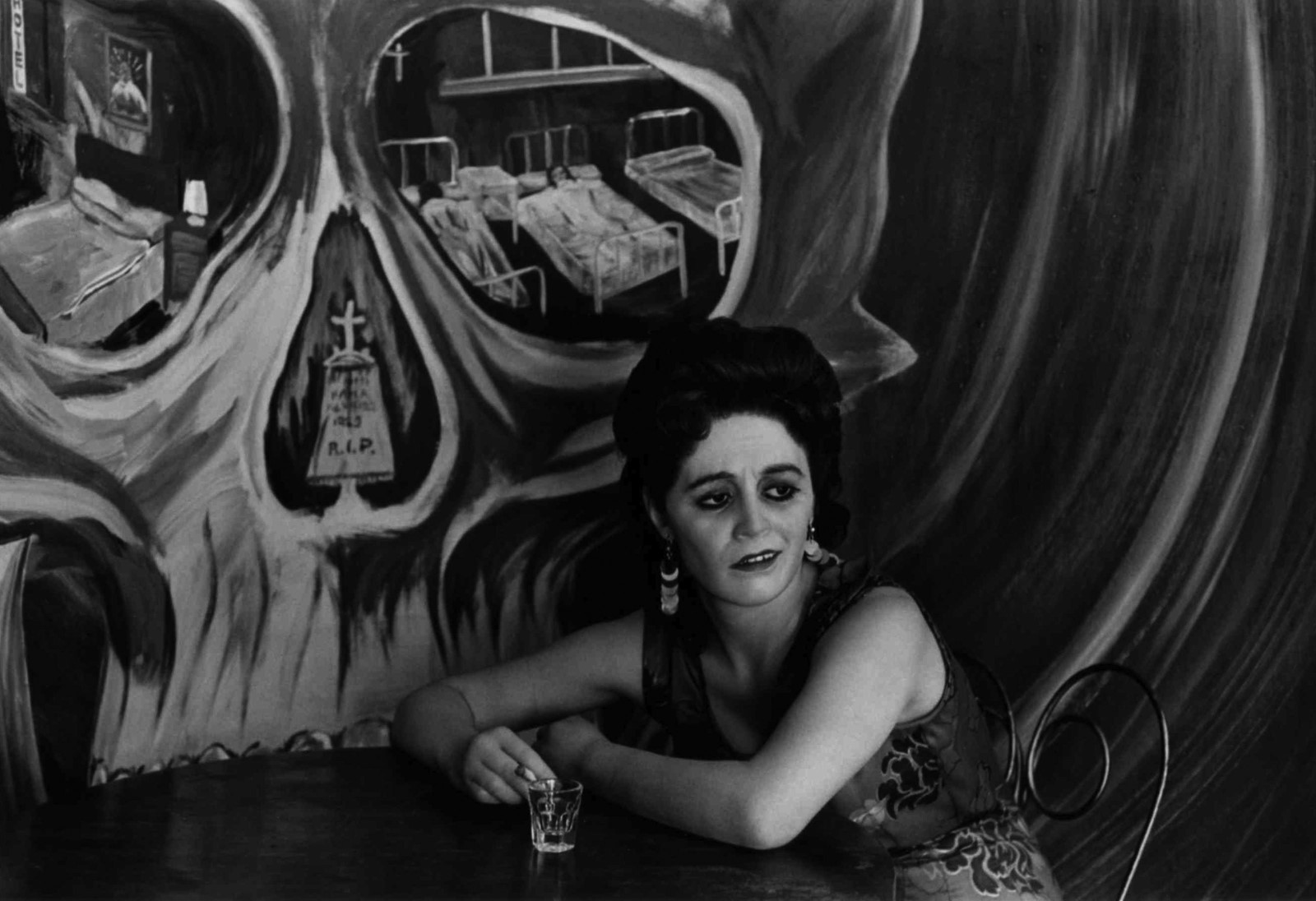


There’s the photograph of a Zapotec woman in a Mexican market, her head draped in a crown of iguanas striking a pose. There is the spectral figure of a Seri wo-man, clad in a long dress, who floats through the desert clutching only a boom box. And there is the woman, with the seen-it-all stare, having a drink and a smoke in a Mexico City bar — her mortality, and ours, writ large in a mural of a skull that looms large over her shoulder.
There are others who are recognizable too: The Zapotec transgender woman framing her striking features with a mirror. A mask-wearing reveler standing in the middle of a dry field, the party over, out of time.
Iturbide’s images are part of museum collections, including the Getty and the San Francisco Museum of Modern Art.
Now 75, Iturbide shows no signs of slowing down. The Mexico City-based photographer recently published the book “Avándaro,” which gathers some of her earliest images — from a 1971 rock fest in Mexico. And she has spent time photographing refugees in Mexico and Colombia, many displaced by drug and other violence, as part of a project sponsored by the U.N. Refugee Agency. (These were shown at the Annenberg Space for Photography last year.)
“That project was really hard,” she says. “It was like touching the misery of man. It was very intense for me.”
This fall, Iturbide and her work will be highly visible around Southern California when the Pacific Standard Time: Los Angeles/Latin America series kick off. Her work will appear in two separate shows for PST: LA/LA, as the series is known.
The Hammer Museum will include her work in “Radical Women: Latin American Art, 1965-1980.” This will consist of images she took in the southern Mexico village of Juchitán in the 1970s and ’80s chronicling life in the matriarchal indigenous settlement. It’s a series that remains her favorite, she says, “because of the closeness I have with the people of Juchitán.”
The Ruth Chandler Wil-liamson Gallery at Scripps College will present works from throughout Iturbide’s career as part of the show “Revolution & Ritual” which will also feature photography by Sara Castrejón and Tatiana Parcero.
Iturbide will also work with artist James hd Brown, the founder of Oaxaca’s Carpe Diem Press, to create a special book of her work tied to the PST: LA/LA show “James hd Brown: Life and Work in Mexico” at USC’s Fisher Museum.
And since all of that isn’t quite enough, she will also be the subject of “Photographic: The Life of Graciela Iturbide,” a new graphic biography by Isabel Quintero and Zeke Peña to be released by Getty Publications in September.
Iturbide has long had a knack for capturing the many layers of Mexican identity — the indigenous draped in the Catholic and the modern. The artist, critic Marta Dahó writes in the Scripps exhibition catalog, is part of a generation of photographers who realized the “complex task of visualizing the survival of [indigenous] cultural beliefs.”
Iturbide is gracious and funny, inhabiting a cozy house in the Mexico City district of Coyoacán stuffed to the gills with books and artifacts accumulated over a lifetime of travel. Following at her heels is a French bulldog named Horr, short for “Horrible.”
In this edited conversation, she discusses some of the high points of her career, why she was compelled to do a series on the cholos of L.A.’s Eastside, and how a youthful stint in a nunnery shaped all the imagery she has produced since.
It’s very strange, no? That image is no longer mine. In Juchitán, there is now a sculpture of her based on that photo. It has appeared as graffiti. There are murals. In Juchitán, she is like a saint. “Our Lady of the Iguanas” is part of daily life. I’m now making a tomb for her. She passed away. I was in Juchitán recently and somebody said, “How is it possible? She is so famous, and look at her tomb.” So I hired an architect to make a tomb for her. And Francisco Toledo, the painter, he is going to create some iguanas to place on there. I imagine it will turn into a kind of shrine. Everybody adores her.
Horrible, horrible. I won’t go to certain communities because of the
The traditions continue. The women are the ones who manage the economy. They are the ones who operate the market. Men cannot enter the market — only
Very intense. The bathroom had been shuttered on Diego’s order, surely because it contained all of her things. Indeed, there were letters and other personal objects. It was very interesting. Like entering a prohibited space, frozen in time — with some terrible smells. Imagine a bathroom that’s been closed off for 50 years.
I wasn’t a Frida-maniac, nor am I now a Frida-maniac. Nowadays she is practically “St. Frida.” But there I learned that she was a marvelous woman who contended with pain. But she kept painting. Painting was her therapy. I feel like I got to know her better.
I was interested in cholos because they are of Mexican origin. I was interested in the ways in which they had been marginalized. I lived there and photographed them. Many had been in jail, then they’d get out of jail and back into gangs. They would get together in the park at night to do drugs, and everyone would respect each other in a kind of cold war. But it was still very dangerous. You’d be taking a picture and then you’d hear [makes the sound of a gun being cocked]. It was very heavy.
For me, it was very interesting, because they have a nostalgia about Mexico that isn’t always based in fact. A group of them told me, “We want you to photograph us by the mural of the mariachis.” And it was a mural of Mexico’s historical heroes: [19th century President] Benito Juarez, [revolutionary] Pancho Villa. They can be really mistaken about Mexico, but they still have a profound nostalgia for it.
I was also very interested in the influence the cholos had. Afterwards, I went to photograph cholos in Tijuana. The cholos there would be looking at magazines that showed cholos in East L.A., so it was interesting to see the paths it took.
I’m occupied by things like rocks — rocks, water, air. These elemental things. But I never know, because something else may arise out of it. I also continue to work a lot in botanical gardens, especially in which the plants are healing from some sort of injury.
I don’t know. Because I’m morbid? [Laughs.] I like to see them with bandages and IVs, gardens that are undergoing some sort of therapy. When the garden has healed, they always want me to photograph it. But I say, “No, that isn’t my garden!”
I wanted to study art, philosophy and letters, but my family was very conservative. They said, “How? No!” But I heard that there was a film school and I just went and enrolled. I had no idea what I wanted to do. But I had the good fortune to meet [Modernist photographer] Manuel Álvarez Bravo, who taught there, and I became his assistant.
I was the eldest of 13. I got married very young — at 19 — and then I got divorced. I come from a very conservative family. They are bishops and archbishops, and you can imagine what I am to them: the crazy one who studies film and gets divorced. Now they accept me, but in the beginning, my parents, what can I tell you?, we didn’t really speak.
I got divorced, and I was very happy. My children are my accomplices. I have two: Manuel [Rocha Iturbide], who is a composer, and Mauricio [Rocha Iturbide], who is an architect.
In a lot of my work, you see the paraphernalia of the Catholic Church: angels, crosses, all of the things I lived as a girl. I was sent to a convent of the nuns of the Sacred Heart. I had boyfriends, so my parents sent me far away. The school was in San Luis Potosí. I was there for three years — as a novice. I had to live there, and you couldn’t speak. I’m an atheist now, but those influences are still there.
They had a huge library. I learned about Spain’s Siglo de Oro [a literary Renaissance during the 16th and 17th centuries]. That was in high school. I left and then I studied for about a year. Then I got married — and then later divorced from the father of my children.
Photography was my salvation.
Yes! Yes, it is.
