


L.A. County centralizes
its homelessness response
A recently created dispatch center aims to better coordinate the many local efforts to get people off the streets and into housing


The request came in June.
A staff member for Los Angeles County Supervisor Lindsey Horvath emailed the county’s newly established Emergency Centralized Response Center, asking for a cleanup of a reoccurring homeless encampment along a rail line in the San Fernando Valley.
Joshua Chung, an analyst with the Emergency Centralized Response Center, or ECRC, said he quickly got to work.
He contacted outreach workers at nonprofits in the area to compile names of people living at the Northridge encampment. He then coordinated with multiple county departments to see if beds were available for those individuals, and if they would qualify for special services because of health problems or drug addiction.
It was all in preparation for the day in late July when crews would arrive at the train tracks and throw away tarps and
Bernice Saavedra said she and her fellow outreach workers at the nonprofit L.A. Family Housing had about a month before the cleanup to contact residents and find them help. Before ECRC, she said they often had just a few days. Sometimes only 24 hours.
“The more time we have to engage, the more time we have to have thorough conversations,” Saavedra said. “There’s a better chance of getting people indoors.”
L.A. County’s Emergency Centralized Response Center launched in January with a goal of better coordinating the various efforts among different government agencies and nonprofits to clean encampments, and get people healthcare and into temporary or permanent housing.
The dispatch center was established following a request from Supervisors Horvath and Kathryn Barger and is part of a larger stated effort to increase accountability and coordination when it comes to homelessness services, including a new county homelessness department that will launch next year.
In the supervisors’ motion requesting the response center, they said there previously wasn’t one entity tasked “to oversee and direct daily operations for unhoused individuals across Los Angeles County” — no small problem when different county departments, federal agencies, state agencies and 88 cities are involved.
Overlap and gaps in services were common.
When an encampment popped up, officials said multiple agencies would receive requests for service and then act on their own, resulting in multiple outreach teams dispatched to the same location, without the knowledge that someone else had been there before.
There were also jurisdictional issues.
Sometimes, a state agency would clean up an encampment on its property, but not notify the local agency that owned the adjacent property, allowing residents to move their encampment there, said Donald Holt, principal analyst with ECRC.
Now, the county says ECRC oversees more than 150 outreach teams across 11 organizations and coordinates with multiple government agencies that offer housing and conduct cleanups to ensure they are working together.
Horvath said the effort is particularly important given the investment the public has made to get people off the streets and the ongoing budget constraints facing all levels of government.
“I am really grateful for all the ways we will now not only be able to deliver results but stretch those dollars further,” Horvath said. “It wasn’t until this center came together that that coordination was really put into action in the ways we all expected.”
Based in an office at the downtown Hall of Records, center staff handle requests for service from elected officials, the public and government agencies and then coordinate cleanups and work to find housing, as well as needed medical care. In addition to eight analysts dedicated to managing requests for specific regions of the county, workers at the center include staff from the county’s Housing for Health, Department of Mental Health, the Los Angeles Homeless Services Authority and the Department of Military and Veterans Affairs, among others.
Chung, who previously worked at the nonprofit
“Now I can just go over and talk to our [staff member] Josh ... and say ‘Hey, Josh, can you see if this
On a recent Tuesday, staff started the day in a meeting where they updated one another on requests for service, including instances in which people were successfully moved into housing and others in which the effort was still underway.
Chung told a group of roughly 20 about a person with autism who was anxious about living in a congregate shelter and was requesting a private room. Chung said staff was working on finding such
Other staff members then chimed in to offer suggestions, including looking for family members or friends who might house the person.
Shortly after the meeting, Chung’s supervisor, Lisa Speights, stopped by the cubicle of Maribel Lozano-Hernandez with the Housing for Health program to discuss a housing request that came in within the last 24 hours.
“You mentioned that client can’t go in until Monday?” Speights asked.
Lozano-Hernandez said that yes, that housing site was likely full until Monday, almost a week later, but she had luck elsewhere.
“I called a different site and [they] can take her today,” Lozano-Hernandez said.
“Oh nice,” Speights responded. She texted the homeless individual’s outreach person with an update.
Holt said ECRC also ensures that when an encampment is located near multiple jurisdictions, representatives from those jurisdictions are present for cleanups.
“We are bringing them all together,” he said. “We are going to have one operation on the same day.”
That’s what happened recently in the San Fernando Valley. The cleanup would show the benefits of coordination and the challenges of making lasting change.
Located along a dirt path on the north side of an in-use rail line, the encampment was on land owned by Union Pacific. Step over the tracks, to the south, and Metrolink is the owner.
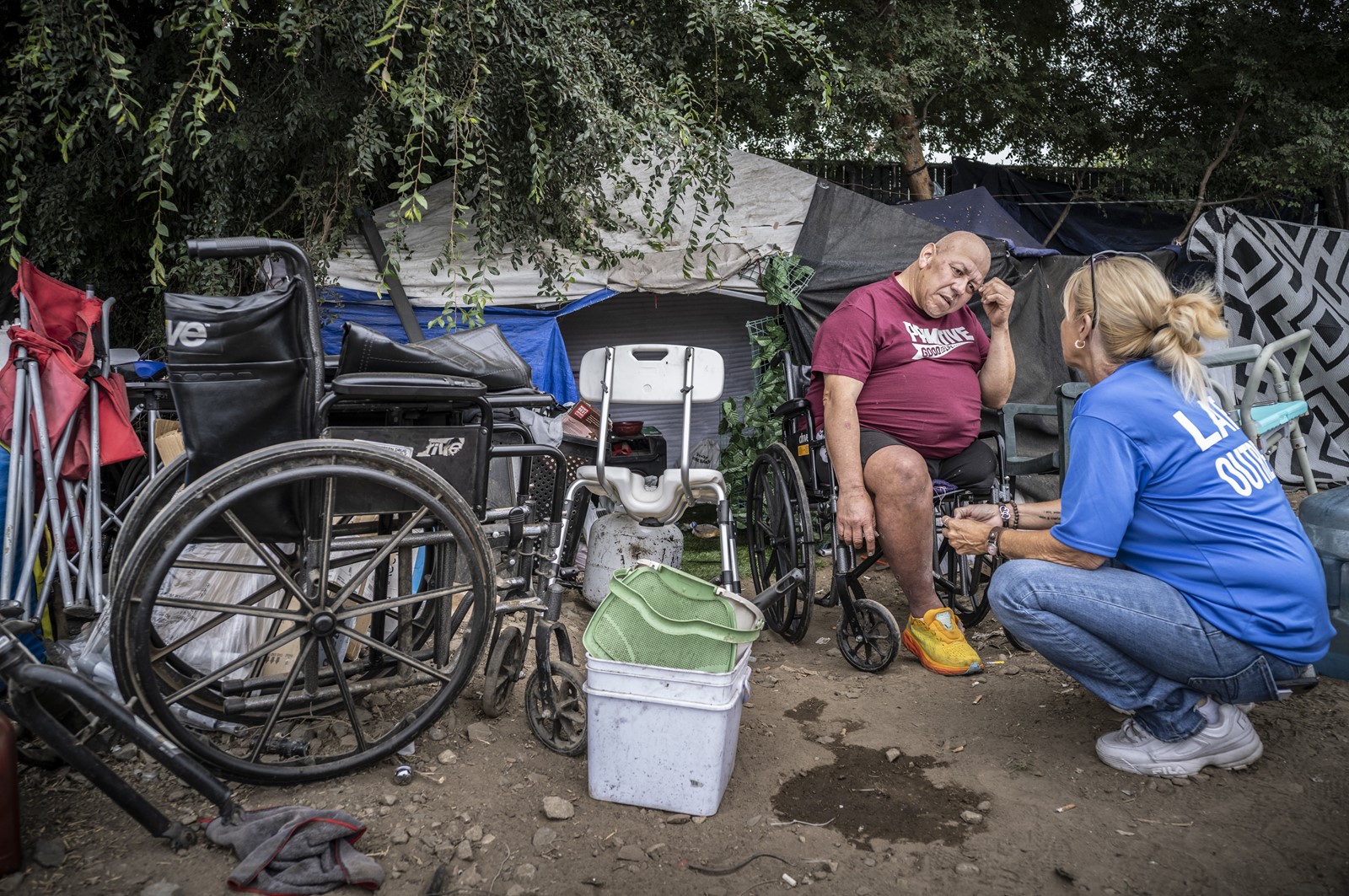
About three weeks ago, outreach workers from L.A. Family Housing arrived to speak with residents, remind them of the following day’s cleanup and encourage them to sign forms to get into housing.
Outreach workers had already been on site about five times and had already located housing options for some of the people living in roughly 10 tents and makeshift structures.
Today among the team, there was a substance abuse specialist and a mental health specialist, as well as a worker who previously was homeless to provide emotional support.
Residents Jose Duran and his partner, Melanie Morales, said they moved onto the streets a few months ago when they couldn’t pay rent after Duran fell from a three-story building and could no longer work in construction.
Speaking as trains zoomed past, Duran said that after he fell from a ladder, his foot became infected and he received skin grafts to fix it, but still needs another surgery.
He pulled up a pant leg to reveal a bulging ankle and said he hadn’t heard from his doctor about when he could get it fixed.
“We have a medical group that can come help you,” Saavedra told him in Spanish.
“Thank you,” Duran replied.
The next day, workers swept through the encampment and moved people out.
By 10:30 a.m., the encampment was gone. The dirt path on both sides of the rail line was clean. According to a county spokesperson, workers removed “four makeshift shelters or tents and 10 cubic yards of debris.”
Duran and Morales weren’t housed that day and said they were told there were no beds available. While deciding what to do next, they waited in a parking lot behind the dirt path they had called home a few hours before.
They said cleanup crews didn’t give them enough time and threw out many of their belongings, including a backpack that held a photograph of Morales’ now-deceased mother.
“It was the only one I had,” Morales said, holding back tears.
Rachel Kassenbrock, the county spokesperson, said that on the day of the cleanup, 10 people from the encampment, including Duran and Morales, weren’t immediately able to be housed, but were put on a wait list until beds became available.
In addition, she said four others were moved into interim housing that day, including Jose Quinonez.
The day before the cleanup, the 48-year-old said he had spent two years on the streets, with drugs and marital problems contributing.
He said he was excited about “starting a new life.”
“I want to fix myself,” Quinonez said. “None of us want to be here.”
Late Wednesday morning, there were about 10 tents and makeshift shelters adjacent to the rail line.
As the temperature neared 90 degrees, one resident sweated as he stripped an electrical wire for copper to sell.
Duran and Morales were there too, asleep inside an orange tent, a black tarp draped over it for shade.
Kassenbrock said ECRC is continuing to work with the remaining residents to get them housed.
Since the cleanup, Kassenbrock said, an additional three people have moved inside.
