


DAVID McCULLOUGH, 1933 – 2022
A first-class author and historian
The Pulitzer-winning writer made history relevant with his storytelling talent.
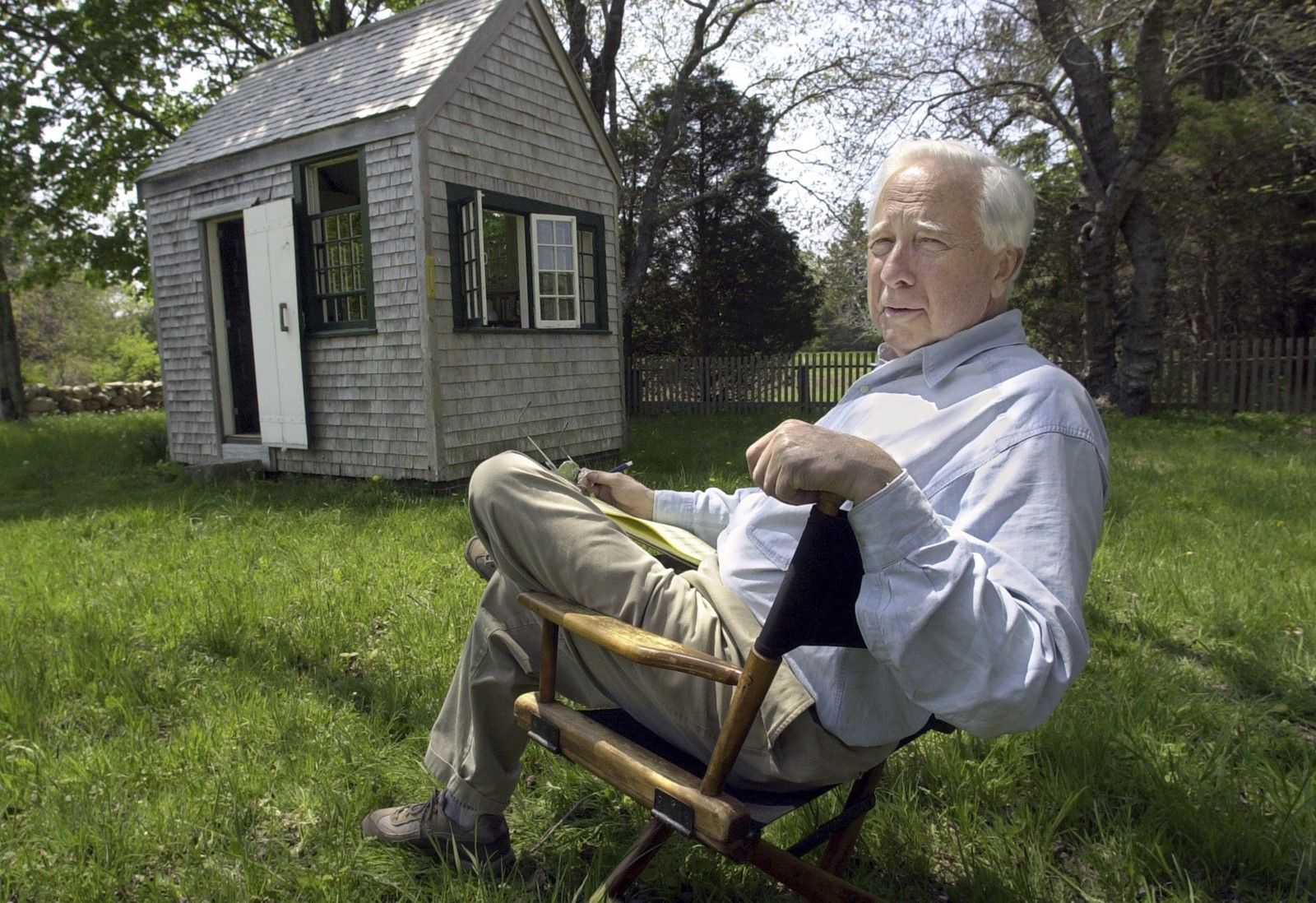


McCullough died Sunday in Hingham, Mass., according to his publisher, Simon & Schuster. He died less than two months after his beloved wife, Rosalee.
“David McCullough was a national treasure. His books brought history to life for millions of readers. Through his biographies, he dramatically illustrated the most ennobling parts of the American character,” Simon & Schuster CEO Jonathan Karp said in a statement.
A joyous and tireless student of the past, McCullough dedicated himself to sharing his own passion for history with the general public. He saw himself as an everyman blessed with lifelong curiosity and the chance to take on the subjects he cared most about. His fascination with architecture and construction inspired his early works on the Panama Canal and the Brooklyn Bridge, while his admiration for leaders he believed were good men drew him to Adams and Truman. In his 70s and 80s, he indulged his affection for Paris with the 2011 release “The Greater Journey” and for aviation with a bestseller on the Wright brothers released in 2015.
Beyond his books, the handsome, white-haired McCullough’s fatherly baritone was known to fans of PBS’ “The American Experience” and Ken Burns’ epic “Civil War” documentary. “Hamilton” author Ron Chernow called McCullough “both the name and the voice of American history.”
McCullough’s celebrations of the American past also led to the toughest criticism against him — that affection turned too easily to romanticization. His 2019 “The Pioneers” was faulted for minimizing the atrocities committed against Native Americans as 19th century settlers moved westward. He also was accused of avoiding the harder truths about Truman, Adams and others and of placing storytelling above analysis.
Interviewed in 2001 by the Associated Press, McCullough responded to criticism that he was too soft by saying, “Some people not only want their leaders to have feet of clay but to be all clay.”
But even peers who found flaws in McCullough’s work praised his kindness and generosity and acknowledged his talent. And millions of readers, and the smaller circle of award givers, were moved by his stories. For years, from a cottage on the grounds of his house on Martha’s Vineyard in Massachusetts, McCullough completed works on a Royal Standard typewriter that changed minds and shaped the marketplace.
He received the National Book Award for “The Path Between the Seas,” about the building of the Panama Canal; and for “Mornings on Horseback,” a biography of Theodore Roosevelt; and Pulitzers for “Truman,” in 1992 and “John Adams” in 2002. “The Great Bridge,” a lengthy exploration of the Brooklyn Bridge’s construction, was ranked No. 48 on the Modern Library’s list of the best 100 nonfiction works of the 20th century and is still widely regarded as the definitive text on the great 19th century project.
McCullough also was a favorite in Washington, D.C. He addressed a joint session of Congress in 1989 and, in 2006, received a Presidential Medal of Freedom.
The historian was nonpartisan for much of his life but spoke out against Donald Trump in 2016, leading a group of historians that included Burns and Chernow in denouncing the Republican presidential nominee as a “monstrous clown with a monstrous ego.” He also had one emphatic cause: education. He worried that Americans knew too little about history and didn’t appreciate the sacrifices of the Revolutionary era.
McCullough took on a few rascals in his books, notably the conniving New York politicians involved with the Brooklyn Bridge, but he preferred to write about people he liked, comparing it to the choice of a roommate. Revulsion at the private life of Pablo Picasso drove him to abandon a planned book on the artist, and his biography on Adams was originally supposed to be on Adams and Thomas Jefferson until the latter’s character also proved too flawed.
McCullough, whose father and grandfather founded the McCullough Electric Co., was born in Pittsburgh in 1933. He loved history as a child, recalling lively dinner conversations and the field trip to a nearby site where Washington fought one of his earliest battles. McCullough majored in English at Yale University and met playwright Thornton Wilder, who encouraged the young student to write. McCullough worked at the United States Information Agency, Sports Illustrated and the American Heritage Publishing Co. before deciding that he wanted to try a book about an event that took place in his home state in 1889 — the Johnstown flood, as big a disaster then as Hurricane Katrina was more than a century later.
McCullough researched the book in his spare time, and pleaded in vain with Little, Brown and Co. to publish it. He ended up with Simon & Schuster, which released the book in 1968 — for an advance of $5,000 — and remained his publisher for the rest of his career.
“The Johnstown Flood” was successful enough that McCullough worried he would be typecast as an author of failure, “Bad News McCullough.” Publishers were asking him to write about the Chicago fire and the San Francisco earthquake of 1906. So for his next book, “The Great Bridge,” he told a story of success. “That I knew little or nothing about civil engineering, that I had never done well in math or physics or had much interest in things mechanical didn’t deter me in the least,” he later wrote. “I was too excited. There was so much I wanted to know.”
McCullough followed with “The Path Between the Seas”; and “Mornings on Horseback,” in 1981.
He had considered a biography of Franklin Roosevelt, but instead related to Roosevelt’s less dynamic, more forthright successor, Harry Truman. He spent the next decade writing the book, living for a time in Truman’s hometown, Independence, Mo., and making a daily routine, as Truman did, of a morning walk.
“Truman,” published in 1992, was a million-seller that capped a long rise in the standing of a man who had left office with an approval rating under 30% and now was virtually canonized as an honest, tenacious leader.
“John Adams,” in 2001, was just as popular and as helpful to its subject, with Congress passing legislation that year to build a monument in Adams’ honor. An HBO miniseries based on the book, with Paul Giamat-ti and Laura Linney, aired in 2008. Tom Hanks was planning a miniseries based on his Wright brothers book.
McCullough had five children and an affinity for happily married politicians that could be traced to his wife, Rosalee Barnes, whom he married in 1954 and who died in June. She was his editor, muse and closest friend. He would proudly show visitors a photograph of their first meeting, at a spring dance.
