


shadowy tale
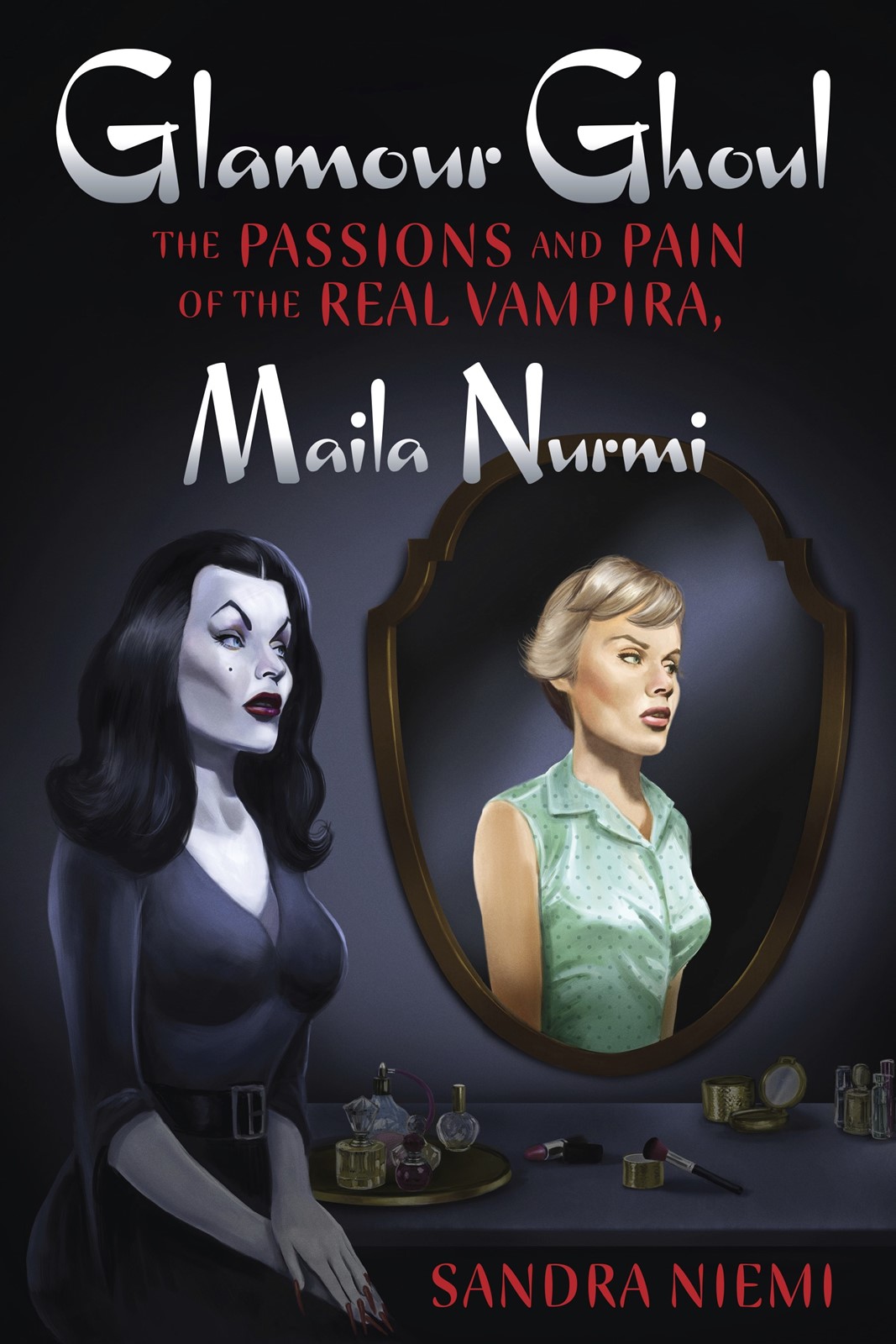
In ‘Glamour Ghoul,’ a niece of Maila Nurmi — better known as Vampira — documents the life of hollywood’s original goth.


“There isn’t much to tell,” she said. “I was born in Lapland. … I have an owl for a house pet. I have a 19-inch waist, 38-inch bust and 36-inch hips. My earliest recollection as a child is that I always wanted to play with mice. I’m very anti-social. I simply detest people. I don’t like snakes; they eat spiders, and I’m very fond of spiders.” Asked how she felt about children, she didn’t miss a beat: “Oh yes … delicious.”
At a time when Lucy and Ricky couldn’t be seen sleeping together in the same bed, Vampira proved that the undead enjoyed more license than the living. She developed the double entendre to a high art (Mae West was a fervent admirer), and while she lifted much of her demeanor from the then-popular Charles Addams cartoons — with liberal dashes of Norma Desmond, the Dragon Lady from “Terry and the Pirates” and Snow White’s evil queen — her Morticia was bigger, sexier and campier.
She was “the first Goth,” says Sandra Niemi, Nurmi’s niece and now her biographer. But the woman who emerges in Niemi’s “Glamour Ghoul” is so much more. Though largely remembered as the vampire most men wanted to, well, date, she was a multitalented, inventive woman who got fewer breaks than she deserved and refused to compromise to make the most of those that came her way. She developed a performance artist persona in bars and nightclubs long before most people knew what being a performance artist meant; she wrote jokes and journalism and designed clothes; and she bent the notions of propriety in an exceedingly tame age.
Unfortunately, it was also an age before digital preservation; almost the entirety of her television record has been lost. She is chiefly remembered for her performance in what is generally considered the worst movie ever made, Ed Wood’s “Plan 9 From Outer Space.” (She insisted on playing a mute so she didn’t have to speak Wood’s horrible dialogue.)
Despite her many ups and downs, however, she enjoyed one lasting bit of good fortune: a devoted niece who worked hard to produce this objective, affectionate biography.
Raised in Massachusetts by Finnish immigrants, Nurmi had a difficult childhood. Her father, a journalist and sometime evangelist, was often traveling; her mother, Sophie, struggled with alcoholism. Long before she became mistress of the night, Nurmi was the mistress of odd jobs. She gutted salmon in a canning factory, performed the “strut and smile” at a traveling carnival and went to Los Angeles at the age of 18 to take advantage of her beauty, along with a talent for hand-stitching outré clothing from thrift store remnants.
She soon met Orson Welles at Musso & Frank, and the affair left her pregnant — by which point Welles had married Rita Hayworth. After giving birth, Nurmi put the baby up for adoption. She was heartbroken, but her hard-drinking mother wasn’t cowed. Sophie Nurmi met Welles many years later, when she was a maid at the Knickerbocker Hotel in Hollywood, and told him about his son. Welles reportedly gave her $200 to go away. “Genius, my ass,” Sophie told him in reply.
But nobody could do less with a good break than Nurmi. She became a successful pinup girl, only to quit and become an actress. Then, when Howard Hawks brought her to Hollywood — his first major discovery after Lauren Bacall — she grew so annoyed by the initial photo shoot that she marched into his office and tore up their contract. It wasn’t the only contract she would shred.
Nurmi attracted — and was attracted to — beautiful men. She had a long relationship with Anthony Perkins, and Marlon Brando often climbed through her apartment window. Well into the 1970s, when she was under financial stress, Brando paid for her telephone line so he could call anytime to discuss his favorite subject — himself. While performing with Liberace in Las Vegas, she met Elvis Presley; she said Elvis later visited her room to give her a private “guitar lesson.”
By far her longest relationship was with James Dean, especially if you count the seances through which they stayed in touch after his death. Dean made an early uncredited appearance on her first show, and they often hung out together at Googies, cavorted in moonlit graveyards and roasted hot dogs over a late-night hobo stove in Griffith Park. “Before I met him,” she recalled in 1966, “I lived in a sea of window dummies.”
She was a woman of intense affections, which were generally mutual. “Maila was the most intelligent person I’ve ever known,” her friend Greg Herger told me. “She was well spoken with a wicked sense of humor and possessed an uncanny knack for seeing right through people within two minutes of talking with them.”
Nurmi’s best work may only be remembered for its paler iterations — such as Lisa Marie’s portrayal in Tim Burton’s “Ed Wood,” or the many sexy vampire Halloween costumes that now adorn our Octobers. And then there were the late-night bad-movie hosts who succeeded her, including Cassandra Peterson’s Elvira, Mistress of the Dark. (Nurmi long pursued, and ultimately lost, a copyright infringement case against the Elvira franchise.)
Now, with Niemi’s biography, the real woman behind the fantasy vampire returns to life. Released by the publisher of Rudolph Grey’s “Nightmare of Ecstasy: The Life and Art of Edward D. Wood, Jr.” (1992), “Glamour Ghoul” is an absorbing, cleanly written and charming portrait of a woman and the Hollywood she clearly loved.
When Niemi learned of her aunt’s death in 2008, she hurried to Los Angeles on “limited funds” and signed the death certificate. Then she discovered dozens of pages of an unfinished autobiography stashed around Nurmi’s apartment — crumpled in the pockets of old shirts, taped to the backs of pictures and calendars. Slowly, she pieced the story together, even though she had never written anything before and felt “riddled with self-doubt.” But she persisted — and for this, lovers of bad movies, macabre jokes and old Hollywood should be grateful.
After she was done writing the book, Niemi managed to make contact with her cousin — David Putter, son of Nurmi and Welles — via Ancestry.com. I reached David to hear his version of their first conversation.
“Imagine being a 75-year-old retired attorney, living a life of comfort and very little remaining drama,” says Putter. “Then one day, through the magic of DNA, you find that your birth mother was a famous vampire. … It was startling, to say the least.”
It’s nice to know Vampira can still startle. “Glamour Ghoul” is an enjoyable book about a fascinating woman — and it puts the nail in Vampira’s coffin in the best possible way.
